

What Is an E-Learning Platform and Its Types, with Real-Time Examples?

TL;DR
- An e-learning platform is a digital solution that enables online learning and communication for schools, universities, corporate organizations, etc.
- Enhanced accessibility, engagement, personalized learning, progress tracking and affordability are significant benefits of e-learning platforms.
- Different types of e-learning platforms include MOOCs, LMS, tutoring marketplace, language learning platforms, corporate training solutions and collaborative learning platforms.
- AI-powered flows, micro-learning, immersive AR/VR technologies, gamification, and data-driven learning are the top e-learning trends shaping the industry.
With shifting learner needs, the technologies and trends shaping the e-learning industry are constantly evolving. Today, the e-learning industry extends beyond massive course platforms and admin-focused LMS.
Modern learners desire engaging, personalized and tailored learning experiences. That’s what has led to various types of e-learning platforms that suit different business and audience needs. In this guide, we’ll explore what is an e-learning platform, discuss its different types, common use cases, show you how to pick the right option and examine the key industry trends.
What is an E-learning Platform?
An e-learning platform is a digital space for hosting, delivering and managing educational content and communication between students and instructors. It enables learning through various tools, such as video conferencing, forums, courses, online quizzes, live chats or AI tools.
Unlike traditional classrooms, students can attend online classes or self-paced courses from anywhere, anytime, at their convenience. E-learning platforms are widely used in educational institutions, schools, and the corporate world. It delivers content through live classes, cohorts, webinars, or self-paced courses.
Top e-learning platforms integrate emerging technologies like AI tools and adaptive learning for a more personalized, interactive learning experience.
Key Capabilities of E-Learning Platforms:
- Course creation and management
- Deliver live 1-on-1 or group sessions
- Track student progress
- Enable assessments, quizzes and exams
- Issue certificates on completion of course module
- Facilitate communication between students and instructors
- Integration with payment gateways, CRM, HR systems, email automation tools, etc.
Benefits of E-Learning Platforms
Digital learning platforms are shifting education from a one-size-fits-all approach to personalised learning experiences. It has eliminated geographical barriers and dissolved time zone limitations, connecting students with subject experts around the globe.
Let’s explore some of the key benefits of e-learning platforms:
1. Engagement
Traditional learning relies on a rigid curriculum, fixed exams and standard metrics. Modern e-learning platforms support videos, audio clips, quizzes, gamification, and simulations catering to different learning styles. This improves conceptual understanding and knowledge retention encouraging them to stay longer on the platform.
2. Accessibility & Convenience
E-learning platforms enable students to learn from anywhere, at their convenience. This is ideal for students from geographically displaced locations or remote workforce teams. Further, most e-learning platforms integrate closed captioning, screen reader compatibility and color contrasts, ensuring an inclusive learning environment.
3. Cost-Effective
Online learning platforms eliminate the expenses related to physical space, rent, printed learning resources and even commute costs. Further, corporate training modules can be scaled to accommodate a large number of employees, cutting down the training and infrastructure costs.
4. Personalized Learning Experience
Adaptive learning paths and AI tools adjust the difficulty of learning modules and even suggest additional resources for skill-building. Personalization helps to tailor content to the learner’s needs, preferences and unique learning style.
5. Progress Tracking & Feedback
Analytics tools track course completion, engagement, and time spent on modules offering data-driven insights to instructors. This helps them to refine their teaching strategies and tailor content to meet learners’ needs.
What are the Types of E-Learning Platforms?
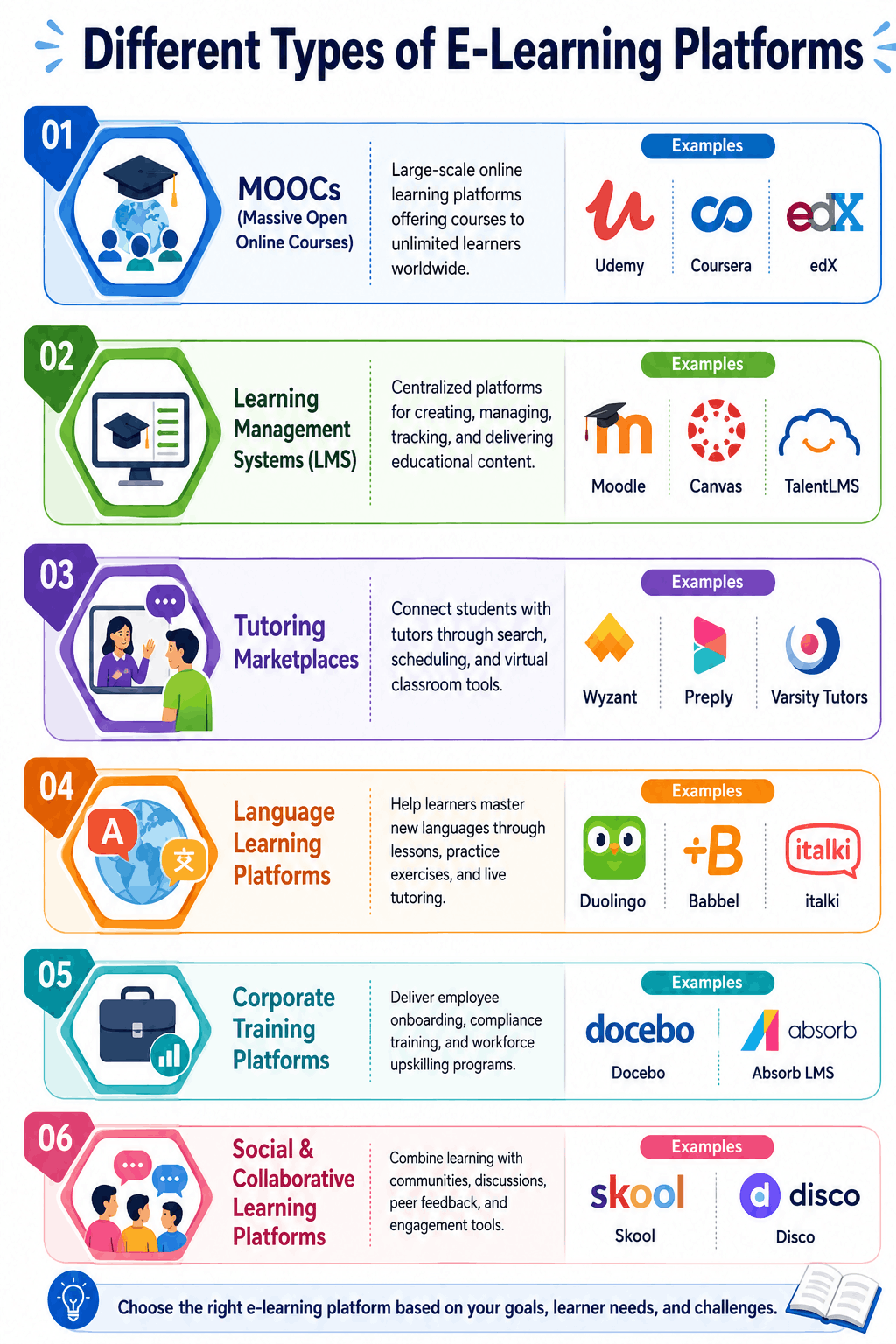
Different e-learning platforms cater to unique platform goals, learner needs and challenges. The e-learning platform that works for a specific organization, might not be right for your business, or vice versa. Hence, it’s crucial to identify your organizational needs first to know what is the right fit.
1. MOOCs
MOOCs stand for Massive Open Online Course. They have gained popularity over the years and are known for connecting educational institutions, instructors and learners worldwide.
Unlike traditional classrooms, an unlimited number of students can enroll in the platform courses. Popular MOOCs incorporate interactive videos, quizzes, forums and certifications for content delivery.
Examples:
- Udemy is one of the most popular course marketplaces, offering over 250,000 on-demand courses across technology, business, marketing and personal development niches curated by industry experts and professionals.
- Coursera is a leading online learning platform that partners with top-tier universities and corporations to offer quality courses, degrees and professional certifications.
- edX, founded in 2012 by Harvard and MIT (now owned by 2U), provides certifications, degree programs and bootcamps to learners worldwide.
2. Learning Management System (LMS)
LMSs are widely used in schools, universities and corporate settings to host, manage, track and deliver educational content. They can be used to manage courses, assessments, quizzes and certifications from a centralized dashboard which learners can access from anywhere.
Examples:
- Moodle is a free, open-source LMS offering a robust space to deliver and manage content in schools, universities, or enterprises.
- Canvas is a modern, open-source LMS with virtual classroom, content delivery, and communication tools for hybrid, physical, or virtual learning.
- TalentLMS is a cloud-based LMS for course creation, compliance training, customer education and sales enablement.
3. Tutoring Marketplace
Tutoring marketplaces are platforms connecting students with tutoring experts through intelligent algorithms, tutor discovery and scheduling systems. They have integrated virtual classrooms, chats and feedback sharing systems for seamless communication.
Examples:
- Wyzant is a popular, trusted tutor marketplace with a vetted network of tutors for academics, test preparation, coding , language ,etc.
- Preply is an online tutoring platform offering 1-on-1 and group sessions, primarily focusing on language learning.
- Varsity Tutors offers high-quality tutoring for academic subjects, test preparation, and college-level subjects.
4. Language Learning Platforms
Language learning platforms help people to master new languages through structured courses, interactive exercises and practice tests. These platforms focus on vocabulary building, grammar, and speaking practice through live tutoring sessions or self-paced courses.
- Duolingo is a popular platform offering gamified, bite-sized lessons in over 40 languages, including English, Spanish, German, Italian and Japanese.
- Babbel is a subscription-based learning platform with short, bite-sized lessons and spaced repetition, helping users master a new language.
- Italki is a personalized language learning platform connecting students with native speakers through 1-on-1 live tutoring sessions.
5. Corporate Training Platforms
If you’re planning to build an e-learning platform for employee training, then corporate learning platforms are the right bet. They enable organizations to deliver employee onboarding, compliance training, and upskilling programs.
- Docebo is a SaaS LMS that supports employee training and customer enablement.
- Absorb LMS is a cloud-based LMS to build and manage training programs for employees, customers or partners.
6. Collaborative/ Social Learning Platforms
Social learning platforms are quite different from traditional LMSs, with highly interactive learning environments. This includes discussion forums, peer feedback loops, and gamification mechanics.
- Skool is an all-in-one learning platform that blends online classroom, discussion forums and live events to deliver an integrated learning experience.
- Disco is an AI-powered social learning platform for self-paced and cohort programs and dedicated community spaces.
Comparison of Different Types of E-Learning Platforms
Here’s a quick comparison of the most common types of e-learning platforms:
| Platform Types | Best For | Revenue Model | Popular Examples |
| MOOCs | Course delivery and large-scale online education | Course fees, subscriptions, certificates, degree programs, commissions | Udemy
Coursera, edX |
| LMS | Schools, universities, businesses | SaaS subscriptions, per-seat pricing, custom enterprise licensing | Moodle, Canvas, TalentLMS, Docebo |
| Tutoring Marketplace | Students and tutors | Commissions, pay-per-sessions, lesson packages | Preply, Varsity Tutors, Italki |
| Language Learning Platform | Language learners and corporate teams | Freemium tiers, in-app purchases, live tutoring | Duolingo, Babbel, Busu |
| Corporate Training Platform | Organizations and enterprises | Enterprise subscriptions, annual plans, per-user pricing | Docebo, Absorb LMS, 360Learning |
| Social Learning Platform | Educational groups, communities and organizations | Membership subscriptions, premium communities, | Skool, Disco |
Common Use Cases of E-Learning Platforms
E-learning platforms cater to different learning needs across a wide variety of scenarios. Here are the different segments of the audience that benefit from e-learning platforms:
1. K-12 Learning
Online learning platforms use personalized learning, virtual classroom, assessments and real-time feedback, encouraging students to learn at their own pace. Another significant advantage is smooth communication between teachers, parents and students.
2. Higher Education
Popular online universities and colleges offer courses, degrees, mastertrack programs and distance-learning programs through platforms like Coursera, edX, etc.
3. Professional Certification & Skill Development
Aspiring learners or mid-level professionals enroll in self-paced courses or cohort programs across technology, management, or marketing fields. This helps them to enhance their skills or progress in their career.
4. Customer Training
Customer training LMS helps organizations to educate and train employees about products and services. They use product tours, use cases, training videos and course modules for better product-adoption and retention.
5. Compliance Training
Organizations need to keep updated with the evolving regulations. LMS platforms help to deliver structured compliance training and certifications across various industries and departments.
6. Lifelong Learning and Personal Development
E-learning platforms are a powerful tool for learning creative and professional skills. For example, Skillshare offers classes with project-focused learning and community across photography, design, AI & innovation, etc.
How to Choose the Right E-Learning Platform?
There are several e-learning platforms out there, hence choosing the right one is a big challenge. If you’re still struggling to decide between a course marketplace or a complex LMS, weighing some key business aspects can help.
Evaluate the following considerations to pick the right e-learning platform:
- Usability & Intutiveness
- Personalized learning paths
- Customization & branding
- Third-party integrations such as authoring tools, video hosting, analytics, etc
- Dashboard & reporting features
- Quality customer support and updates
Future Trends Shaping the E-Learning Platform
As the world of e-learning continues to evolve, platforms need to adapt with the trends shaping the industry. The shift is towards building interactive, personalized and efficient learning experiences.
Some of the top e-learning trends to watch for in 2026 include :
- Artificial Intelligence (AI): Like all other industries, AI is swiftly becoming an integral part of the e-learning industry. From helping to create content faster to personalized learning paths and tailored assessments, AI-powered flows are constantly improving learner outcomes. Hence, many e-learning platforms are actively integrating AI tools in their interfaces.
- Augmented Reality (AR) and Virtual Reality(VR): These immersive technologies spice up boring topics with realistic simulations. Be it a virtual field trip to Mars or letting students conduct virtual science experiments, AR and VR boost interactive and experiential learning.
- Gamification: Points, leaderboards, badges, and streaks are powerful gamification strategies to maximize engagement and keep the fun element intact. It has been widely used in K-12 and corporate learning to incentivize learners with rewards and keep them motivated to meet their goals.
- Data-Driven Learning: Analytics tools provide detailed insights into student progress and engagement and identify trends early. This helps both students and teachers to adapt unique instructional methods and improve the learning process.
- Micro Learning: This involves breaking down larger, complex concepts into small, modular, easy-to-digest ideas. With the reduced attention span, bite-sized learning videos, quizzes, short games, or ebooks can enhance learners’ engagement and completion rates.
Conclusion
E-learning platforms offer numerous benefits, including effective course delivery, flexibility and cost-effectiveness. Whether you’re looking to offer professional certification, corporate training, or custom training, choosing the right e-learning platform makes all the difference. Start by identifying your business needs, researching the top software providers and comparing their demos and features to make the right decision!
FAQ-Related to What is an E-Learning Platform
1. What is the definition of e-learning?
E-learning platform is a digital tool for delivering and managing educational content and facilitating communication between students, instructors and parents.
2. What is the difference between an LMS and e-learning platform?
LMS is a centralized software for managing, delivering, and tracking educational content. On the other hand, an e-learning platform is a broader term focusing on content creation and delivery.
3. What are the key features of an e-learning platform?
Content creation and management, assessment, video conferencing, payment integration, communication tools, dashboards and analytics are the key features of an e-learning platform.
4. How much does it cost to build an e-learning platform?
The cost of developing e-learning platforms is approximately $40,000 to $100,000+, depending on the platform complexity, tech stack and customizations.