
How to Build an Online Course Platform: An Ultimate Entrepreneur’s Guide

TL;DR
- Building a successful course platform requires initial market validation, a solid business plan, MVP features, a creator acquisition approach and an effective launch and promotional strategy.
- Prioritize user-friendly UX, easy course builder, reliable video hosting, communication tools, built-in payment flows and analytics.
- Custom development is expensive ($40,000 to $1,00,000); ready-made course marketplace clone scripts like Pinlearn are a cost-effective alternative, reducing the costs by 50% ($700 to $1500) for MVP development.
The online education market is worth $101.09 billion in 2026 and is estimated to reach $225.33 billion by 2030. There is still much potential in this industry; hence, it’s the right time to launch a course platform and build a profitable business in the growing industry.
However, launching an online course platform requires an understanding of marketing, technical, and operational challenges. Cost is another stumbling block for first-time entrepreneurs. Building the entire feature stack, including the course builder, video streaming, payment gateway, and analytics from the ground up, is expensive. That’s where ready-made course marketplace clone scripts help you launch your platform within $1500.
This blog is a comprehensive guide on how to create an online course platform in a cost-effective way, along with the best practices!
How to Create an Online Course Platform: 7 Step Guide
Building a course platform requires a solid business plan and right execution. Below we have put forth the detailed steps to build a successful course platform:
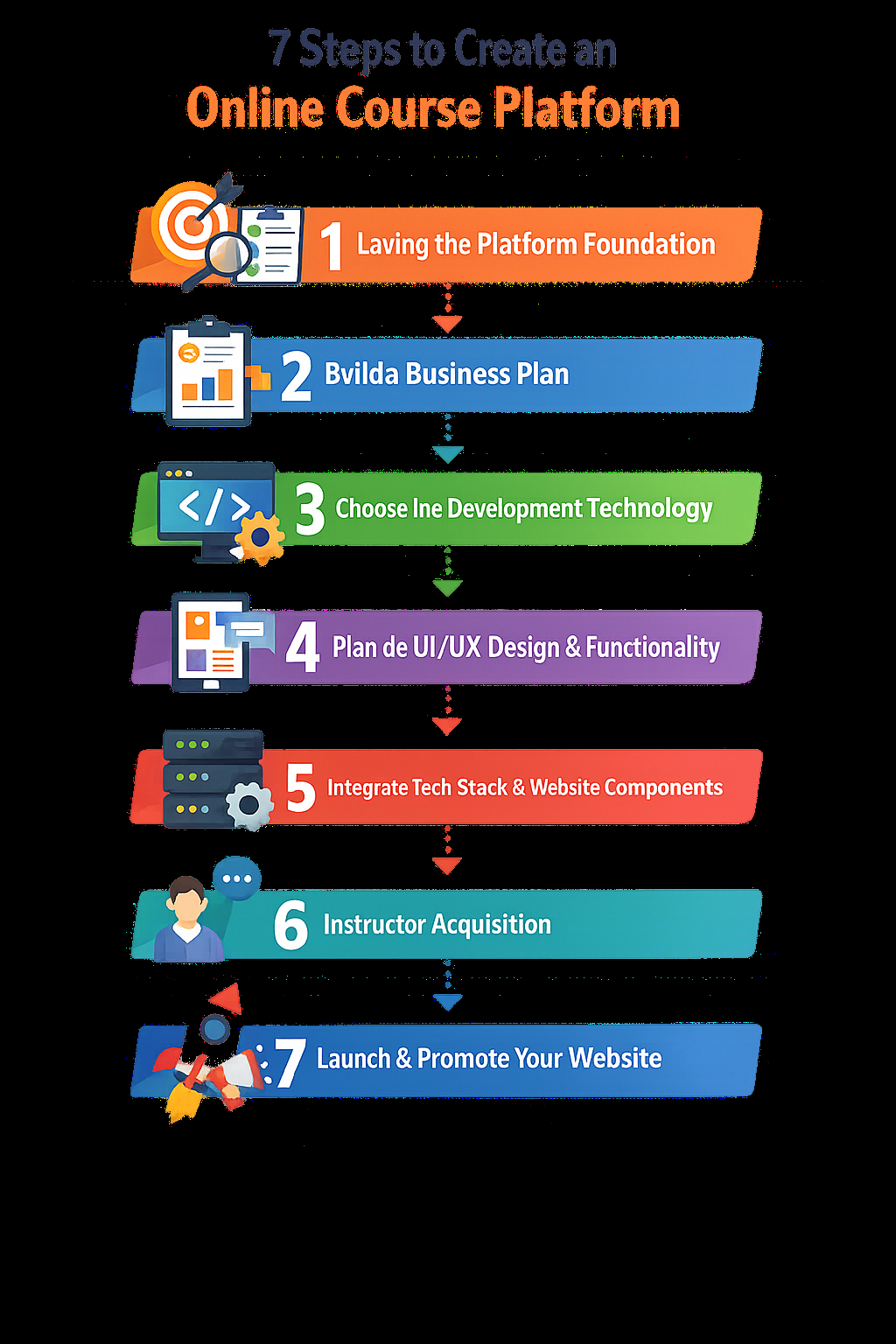
Step 1: Laying the Platform Foundation
The first step to building a successful online course platform is market research and niche analysis. This lays a powerful blueprint for a robust course platform. These initial steps ensure your platform meets learners’ needs, expectations and addresses their pain points.
Identifying a Profitable Niche
The online course market is competitive. With platforms like Udemy, Coursera and edX, already earning a profitable revenue, you must determine what makes your platform stand out. This requires a deep understanding of learner psychology, competitors, and your technical capabilities.
Ask the following questions:
- Is there a real problem that my course platform solves?
- Who is my ideal target audience?
- Does my niche have an actual market demand?
- What is my unique selling proposition?
- Is my niche scalable?
Currently, the top-demanding niches are tech and programming, personal development, health & fitness, design and creative skills, language learning, exam and test preparation.
To narrow down your niche, focus on a demographic, a real market gap or existing platform trends. This helps you offer a unique solution and establish your platform as a go-to expert.
Understanding Audience
Once you have a clear niche, it’s time to define your ideal learner persona. This requires you to get deep inside their mind. Understand their objectives, challenges, interests, background, and learning preferences.
Maybe you’re building a digital marketing academy for working professionals. You need to tailor the curriculum based on their skill level. Or perhaps, include real case studies and examples, rather than theoretical concepts. Research your audience on subreddits (e.g., r/onlinehelp, r/onlinecourses, r/elearning), focus groups, social media, and through interviews.
Market Research & Validation
Market analysis helps to gain valuable insights about your competitors and trends. It helps to explore the opportunities in the market and position your platform accordingly.
Gather all the information about your competitors: course offerings, pricing model, marketing strategies, target audience, technology, etc.
Step 2: Build a Business Plan
Your business plan acts as a roadmap for development, marketing and financial sustainability. Without a clear plan, there is an increased chance of failure and operational fallouts.
Course Scope & Strategy
Your course catalog’s breadth and quality determines your platform’s success. Include popular course categories such as AI, programming languages, data science and machine learning.
Also, decide whether you’re planning for a text-heavy or an interactive course?
Some popular content formats include:
- Video lessons
- Audio clips
- Quizzes
- Slides
- Assignments
- Case studies
Set the course quality standards and review checklist (e.g., video and audio quality, course coverage, and instructor credibility). Provide a portal to upload the course for review, outline the entire process and approval timeline.
Monetization Model
Now that you have built your course strategy, it’s time to pick the right revenue model to monetize the content.
Here are the most popular e-learning monetization strategies:
| Monetization Model | How does it work? | Platform Examples |
| Subscription | Much like Netflix of learning, subscribers pay a monthly fee to access the entire course library. This brings in predictable revenue for the course platform, but the challenge here is keeping the content fresh. | Coursera, Skillshare |
| Pay-per-course | Here, learners pay for individual courses and get life-time access. This model offers low entry barrier, high flexibility, but demands a strategic pricing approach. | Udemy, Coursera |
| Freemium | This model offers the basic content for free, while charges for full course access or certificates. Advantages include more upsells, it attracts a wide user base, and builds trust. | Khan Academy |
| Commissions | In the revenue sharing model, the platform takes a cut from instructor’s earnings when they make a course sale. The upsides of the model are high scalability, performance-based pay and reduced risk. | Udemy, Coursera |
Financial Budgeting
Ask this question: How would your platform sustain over the next 3-5 years? Well, to explain that, you need to make realistic financial projections for your course platform.
Your budgeting must include:
- Different monetization streams and corresponding revenue percentage
- Pricing assumption for courses, membership, certificates, etc.
- Revenue projections based on the number of sales
- Funding requirements
- Platform development cost
- Additional costs such as hosting, content production, marketing, and third-party tools
This helps to evaluate the financial viability, funding needs and the right pricing structure.
Step 3: Choose the Development Technology
The technology you choose to build your course platform decides how your platform operates, scales, and even how much revenue it makes.
This brings us to the two main development approaches: ready-made course marketplace clone scripts and custom development.
Let’s see how both approaches stack up against each other!
| Comparison Aspect | Ready-made Course Marketplace Clone Scripts (Pinlearn) | Custom Development |
| Cost | Low ($700 to $1500 for MVP). Since all the essential features are pre-built. | High ($40,000 to $1,00,000+). Here you must build the entire platform from scratch. |
| Launch Time | 5-6 days | 4 to 12 months |
| Technical Skill | Not Required. The clone script provider handles coding and technical side for you. | High. You are responsible for development, launch and testing. |
| Maintenance Cost | Low. Managed by the clone script providers and free updates for the first year. | High. You have to manage software updates, security and backups. |
| Customization | High. Full source code ownership, premium add-ons, and even you can hire development engineers. | High. Customization can extend the development cycles. |
| Scalability & Growth | High. Supports high performance, access to source code and built-in marketplace. | High. Businesses can build tailored course platforms but require a high budget. |
| Risk | Low. Built on a proven model, reducing failure risks from trial-and-testing errors. | High. Might involve budget overruns, project delays, and development gaps. |
Why Choose Pinlearn?
Pinlearn is an all-in-one solution to build course platforms like Udemy, Coursera, Khan Academy, and edX. It offers easy course management, built-in payment gateway integration, marketplace support, advanced tutor and admin dashboards, and analytics.
Here’s how Pinlearn stands out:
- Powerful course creation and management capabilities
- Supports live classes and self-paced learning
- Launch your live website in 7 days & with free 1-year support
- One-time cost and lifetime license
- Open source code access in the professional plan
- Advanced analytics & reporting
- GDPR-compliant
- Premium add-on ecosystem and full customization support
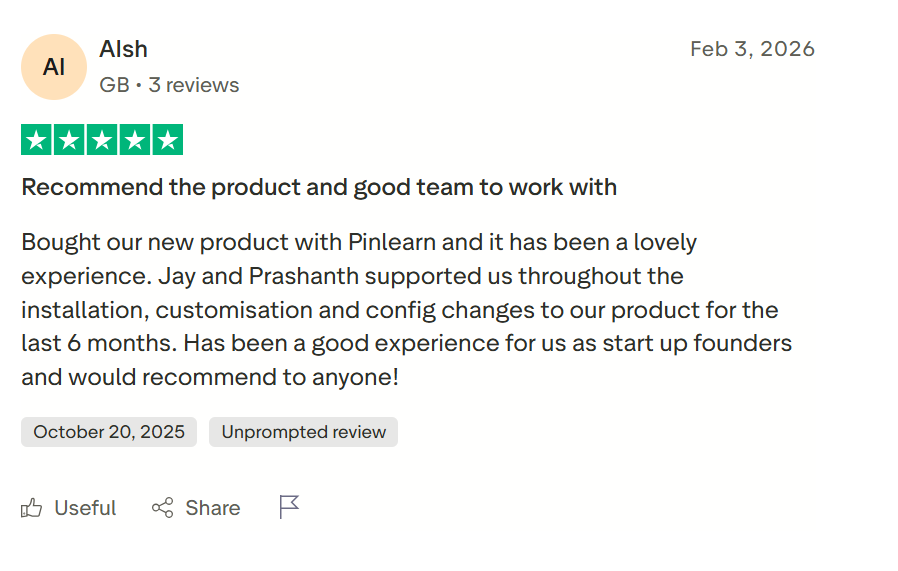
Another amazing review from one of our clients:
Step 4: Plan the UI/UX Design & Functionality
Effective platform design and the right set of features empower learners to meet their goals. This facilitates easier learner interactions, superior user experience, and increased platform revenue.
Defining the Core Functionality
The right platform features depend on your platform goals, niche and target audience.
Here are the essential features to launch your course platform:
1. Login & Profile Creation
Enable learners and instructors to register and securely access your platform. To make the process convenient, add social logins and two-factor authentication.
2. Smart Course Search & Filtering
As your platform grows, your course library expands and finding a specific course becomes tedious for learners. That’s where a robust search tool with filtering comes in! Allow learners to sort the courses by price, course topic, level or instructor.
3. Course Enrollment & Payment
Build a simple and effective course enrollment process for free and paid courses. Add an easy checkout process, multiple payment options like cards, wallets, EMI, etc., to maximize course sales.
4. Communication Tools
Chats, dedicated course groups, discussion forums, and Q&A dashboards keep learners and instructors connected. Niche communities encourage interactions and keep them engaged.
5. Interactive Features
Allow instructors to enrich courses with MCQs, short quizzes, or assessments, coding practice tests, etc.
6. Course Management Tools
Build intuitive and drag-and-drop-friendly course creation interfaces. Support multiple course formats such as videos, audios, quizzes, PDFs, etc. AI course creator helps to generate course modules, quizzes or images in minutes.
7. Payment & Monetization
Integrate with trusted payment providers like Stripe or PayPal for secure payments. Add payment features based on your revenue model. For instance, auto-renewal and cancellation features for subscriptions, or premium upsells like certification fees for the freemium model.
8. Video Streaming & Hosting
This is one of the most significant features for course platforms. It is the core technology that enables learners to access their course videos via DRM, encoding, and adaptive streaming.
9. Dashboards & Analytics
A comprehensive instructor dashboard helps to manage and upload courses, track enrollments, overall earnings, course performance, and view ratings.
10. Admin Panel
Admin can track users, instructors, revenue, payouts and platform settings from a single dashboard. The detailed reports offer data-driven insights to make better decisions.
11. AI Features
Personalized course recommendations, predictive analytics and learning assistants automate various workflows and enhance platform experience.
12. Platform Design
Learning shouldn’t feel like a chore. From personalized onboarding to interactive courses and gamified experiences, everything makes learning engaging, intuitive and accessible.
Think about it this way: Imagine a learner taking up Spanish classes on Duolingo. The learner receives a reminder notification and takes up 10-minute quick lessons every day. Slowly, daily streaks, XP points, milestones and progress dashboards makes learning a consistent habit.
Some tips to design an appealing course platform:
- Clear menus & easy navigation
- Simple & responsive layouts
- Intuitive controls for finding courses
- Subtle colors matching your branding and voice
- Mobile-first approach enabling access from tablets, desktops and smartphones
Step 5: Integrate Tech Stack & Website Components
Your tech stack powers your course platform. The right technology decides how easily you can add features, scale operations, and integrate with external systems. So, choose it wisely!
Essential Tech Stack & Website Components:
| Technology Aspect | Tech Stack | Purpose |
| Frontend | React.js, Next.js, Vue.js. | Design interactive and responsive interfaces |
| Backend | Node.js, Python | Handle logic, payments, authentication and more |
| Database | PostgreSQL, MongoDB, Redis | Store user data, course catalog and content, transactions, progress and certificates |
| Hosting | AWS, DigitalOcean, Linode, Hostinger | Stores website files, databases, media, and content. |
| Video Hosting & Streaming | Mux, CloudFlare | Manage access to pre-recorded course videos |
| Domain Name | GoDaddy, Namecheap, and Cloudflare | The course website’s address on the internet. |
| Payments | Stripe, PayPal (Ensure revenue split feature) | Manages subscription payments, one-time course purchases, upsells, etc. |
| Security | OAuth, JWT Authentication | User authentication and secure login |
Step 6: Instructor Acquisition
Your instructors are the powerhouse of your platform! The instructor expertise shapes your website content and ultimately, drives revenue. Another challenge new course platforms experience is hiring instructors with absolutely no reputation or success stories.
Even Udemy struggled to find its initial instructors with 6 months of cold calling, ultimately finding the first 1,000 course creators.
Here’s how Udemy solved the classic chicken-egg problem with this 3-step funnel:
- Getting a lead by outsourcing the lead generation process to oDesk (now Upwork).
- A/B email performance testing
- Boosting conversions by supporting instructors with a course promotions
Other effective acquisition strategies you can implement are social media outreach, leveraging your network, founder member incentives and early success stories.
Step 7: Launch and Promote Your Website
Now that your course platform and content are ready, it’s time to launch and monetize from it. Start with a pre-launch marketing strategy of building a strong brand presence. Design your brand logo, tagline, and colors. Build a coming soon page or pre-launch landing page to generate buzz and capture email addresses.
Here are some effective marketing ideas to expand your reach:
- Social media marketing
- Paid advertising
- Referral programs
- SEO
- Email marketing
- Partnerships
- Affiliate marketing
We have a full marketing playbook for e-learning platforms to expand reach and attract more users.
We have come to the end of this “how to create an online course platform” guide! Now, let’s understand the cost involved to build an online course website.
How Much Does it Cost to Build an Online Course Platform?
The cost of developing an online course platform is $40,000 to $1,00,000+ approximately. Platform complexity, development approach, tech stack and third-party integrations influence the final project cost. Using white label clone scripts reduces the development cost to $700 – $1500, enabling entrepreneurs to focus on marketing and scaling their business.
Development Cost Based on Complexity Level:
| Complexity Level | Estimated Cost |
| Basic Platform (MVP) | $40,000 to $60,000 |
| Medium-Level Platform | $60,000 to $80,000 |
| Advanced Platform | $80,000 to $1,00,000+ |
Legal Requirements For Building a Course Platform
Most course platforms and marketplace overlook the legal landscape. Draft your platform’s Terms of Service (TOS), privacy policy and data collection mechanisms as per standard regulatory frameworks.
Key Legal Areas for Compliance:
- Business Structure: Set up your course platform as an LLC, corporation or partnership. LLC separates personal assets and business liabilities, safeguarding you from lawsuits or business debts.
- Formal Approval: If you’re launching a course platform offering accreditation or professional degrees, you need a formal approval from external regulatory and accreditation boards.
- Data Protection & Compliance: Adhere to global laws like GDPR (EU), and COPPA and CCPA (US) while handling confidential user data.
- Copyright Protection: Establish a copyright takedown notice process to report infringed content and ensure all creators own the copyright for their work.
Do’s and Don’ts While Building an E-Learning Platform
Below are the key practices to follow while developing an e-learning platform:
| Do’s | Don’ts |
| Plan to scale your architecture to accommodate growing traffic and technology needs. | Skip market validation and competitor analysis. |
| Prioritize mobile-friendly & responsive design. | Overload MVP with a whole lot of features. |
| Hire quality instructors with expertise, right qualifications and communication skills. | Skipping testing before launch. |
| Choose marketing strategies that align with your audience and revenue model. | Prioritizing UI/UX design over course content. |
| Build a mailing list and send weekly newsletters on industry insights and trends. | Choosing a cheap and rigid technology stack that limits scalability. |
Conclusion
By following these steps, you can launch a course platform that aligns with your niche and target audience. If you’re new to this space, you need not handle the challenging technical aspects alone, we are here to help you! Whether you need guidance with the business plan, feature selection, or development technology, our team of experts can guide you at every step.
Book your quick 15-minute discovery call and get the complete roadmap to launch your course platform!
Further Reading:
FAQ-Related to How to Create an Online Course Platform
1. How to create an online course website?
Conduct market research, build a solid business plan, identify MVP features, choose the right development approach, hire course creators, launch and market your platform.
2. What is the cost of building an online course platform?
The cost of developing a course platform ranges from $40,000 to $1,00,000+ approximately, depending on platform complexity, tech stack, and integration. E-learning clone scripts are an affordable way to launch your course platform under $1500.
3. How long does it take to create an online course website?
Custom development takes 4-12 months, while ready-made clone scripts help you launch your platform within a week.
4. Do I need to know coding to launch a course platform?
Using course management software like Pinlearn, you can launch a powerful course platform without coding knowledge.
5. Which payment gateways should I integrate to my online course website?
Stipe, PayPal, Square, Authorize.net, and Braintree are trusted payment gateways for e-learning platforms.
6. How can I integrate video hosting and streaming?
Choose reliable video hosting providers like Vimeo, Cloudflare, Wistia, DaCast are top video hosting providers.
7. Which is the best monetization model for online course platforms?
Subscriptions, pay-per-course, freemium, and corporate partnerships are popular revenue models.