
How to Build a Website Like Varsity Tutors: A Detailed Guide
TL;DR
- The Tutoring Platform Development Path: To build a website like Varsity Tutors, start with a profitable tutoring niche, validate your idea, plan monetization, identify must-have features, maintain trust and compliance, hit the launchpad and scale over time.
- Powerful Core: Must-have features include secure login, seamless tutor matching, live classroom feature, secure payment integration, reviews & ratings, communication tools, deep analytics, and reporting.
- Shortcut to Foundation: Ready-made tutoring software providers like Pinlearn helps you skip the 4-12 month development grind and cut the $40,000 to $150,000 budget to focus on product differentiation.
Founded in 2007, Varsity Tutors has transformed from a one-on-one tutoring marketplace to a comprehensive educational system. The platform was born out of founder Chuck Cohn’s personal experiences when he struggled to find high-quality tutoring for his university courses.
That’s what led him to build Varsity Tutors, facilitating over 10 million hours of tutoring sessions across over 3,000 subjects. Many entrepreneurs and startups are inspired by the platform’s success and business growth. If you’re also someone in a similar pursuit, this guide offers the complete roadmap on “how to build a website like Varsity Tutors.” So let’s get into deep dive!
How Do Varsity Tutors Work?
Varsity Tutors operates more like a managed tutoring platform offering tutor matching assistance and interactive learning environment. The platform has a dedicated group of educational consultants who consider every learner’s unique style, needs and connect them with tutors.
First, students purchase a tutoring package, then an educational consultant reaches out to them. They gather all of the student information, including tutoring needs, academic goals, availability, etc. Once that is done, the team suggests a tutoring expert who best fits the learner’s needs.
The robust tutor matching algorithm goes beyond basic search functionality. And uses over 90 unique attributes to find the right tutors aligning with students’ needs. Next, live tutoring sessions are hosted in an interactive environment with whiteboard, chats, and other integrated tools.
The platform supports both 1-on-1 and group tutoring sessions, membership plans, test preparation services and school partnerships. In addition to live tutoring services, Varsity Tutors also offers 24/7 on-demand tutoring and homework help. Its revenue model is centered on recurring memberships, individual tutoring sessions and institutional contracts with universities and schools.
Tutoring Market Landscape: Varsity Tutors, Wyzant, Preply and Other Competitors
Understanding the competitor landscape better helps tap into the top tutoring trends and position the tutoring platform more effectively. Research the top tutoring platforms, their strengths, business model and marketing strategies.
Let’s look at the key players in their tutoring industry!
| Tutoring Platform | Revenue Model | Target Audience | Key Features |
| Varsity Tutors | Monetizes from premium membership plans, individual tutoring sessions, and institutional contracts | K-12, learners seeking test prep services, institutions, parents | Comprehensive tutor matching systems, large network of vetted tutors, test preparation services |
| Wyzant | Two-sided marketplace model (25% commission fees) | K-12, Learners seeking test preparation services, university students, professionals | Robust tutor search & discovery, customized lesson plans, flexible scheduling |
| Preply | Commission-based model, charging 18%-33% commissions on every lesson | Language learners, students preparing for language exams, professionals | Global language tutor network, flexible pricing, tutor discovery system |
| Italki | Marketplace model earning from commissions on individual lessons and lesson packages | Language learners, international students and professionals | Community-driven learning, native language speakers, conversational-speaking practice |
Step-by-Step Guide to Building a Website Like Varsity Tutors
In this section, we outline the essential steps to create a website like Varsity Tutors, from initial business planning to the final deployment.
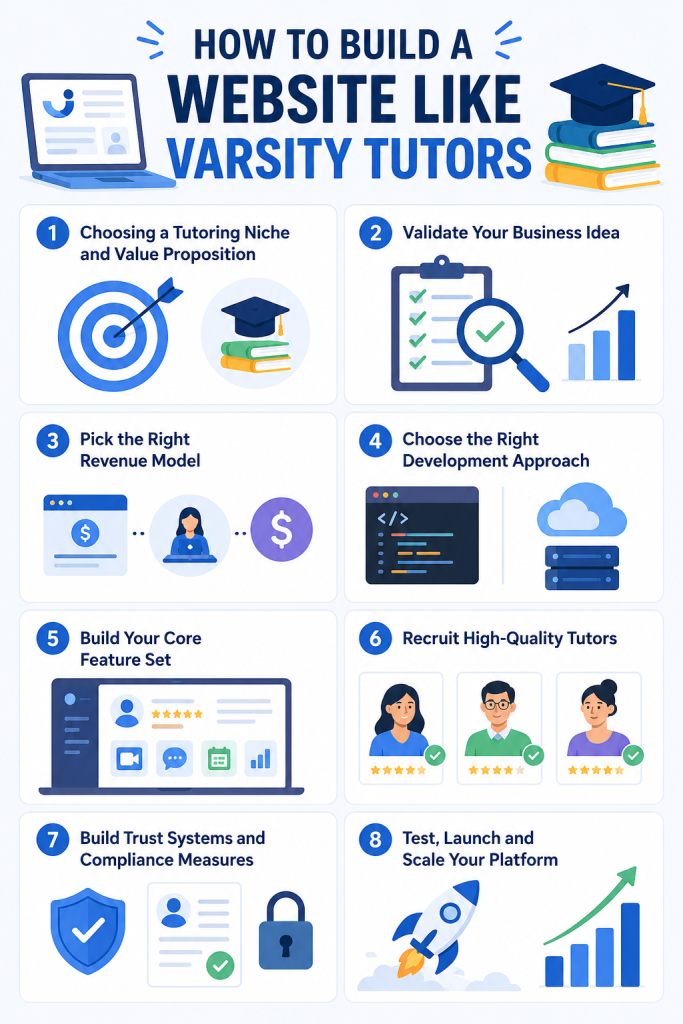
Step 1: Choosing a Tutoring Niche and Value Proposition
The online tutoring market is fiercely competitive, with several established and emerging platforms holding the market space. To stand out, you need to go that extra mile beyond launching a generic marketplace.
Successful tutoring marketplaces focus on:
- Specialized subjects or skills (Coding, creative writing, advanced mathematics, or specific language skills)
- Targeted audience (K-12 learners, professionals, international students, B2B partnerships)
- Unique teaching methods (project-based learning, niche communities, gamification, AI-powered paths)
- Regional or underserved language
Research your competitors, their tutoring offerings, pricing models, teaching approaches and marketing strategies. Identify the platform gaps you can scale on through testimonials, review sites, and even subreddits. This groundwork helps to position your platform right and ensures long-term business growth.
💡Related: How to launch a niche learning platform?
Step 2: Validate Your Business Idea
Before moving on to the planning & development process, it’s important to validate your business. Both tutors and students should find your business idea compelling enough.
For user validation, directly outreach to potential users on study groups, subject-specific forums, or parent communities. Gather information on learners’ pain points, learning experiences, and challenges. You can start a discussion in the group by pitching your idea or running a poll and observe the responses.
Connect with tutors on job boards, teaching communities, or professional networking groups. Try understanding their expectations, motivations and current challenges.
Other ways to validate include building a platform prototype or a landing page for your platform. Collect email sign-ups of interested users; this is your potential target audience.
Step 3: Pick the Right Revenue Model
An innovative e-learning business model fuels the long-term success of your tutoring platform. Choosing the right monetization streams balances the revenue flow and profits.
Here are the top monetization strategies to include:
- Platform Commissions: Charge a standard commission (15% – 25%) on every platform session.
- Premium Subscriptions: Offer memberships with live tutoring sessions, on-demand courses and learning resources on monthly subscription fee.
- Strategic B2B Partnerships: The platform delivers high-dosage tutoring and AI personalization for schools and districts, typically charged on per-student or per-program basis.
- Freemium model: Offer basic tutoring services for free and charge for premium services or additional resources.
Step 4: Choose the Right Development Approach
This is a fundamental step for entrepreneurs and businesses impacting your platform’s scalability, budget, customization and launch time. The right choice depends on your platform goals, budget and technical skills.
Custom development and ready-made solutions are two approaches to platform development.
Here we explain both the development approaches in brief:
Custom Development
Building a tutoring platform from scratch offers flexibility, full ownership and complete control. This approach is ideal for businesses with highly unique business requirements or legacy systems. Here, you need to hire experienced developers to build all the features and functionalities and oversee the entire development process. An extensive budget and a lengthy project timeline delays the market entry and validation.
Ready-Made Solutions
Platforms like Pinlearn encourage rapid platform development without any coding knowledge. With pre-built features, businesses can launch early, validate concepts, and iterate quickly based on user feedback. This provides entrepreneurs a competitive edge, proven business model, and reduced long-term cost.
And that’s not all, modern ready-made clone scripts are fully-customizable, and offer white-labeling support. You can launch a tailored tutoring platform within days and customize as the platform grows.
Step 5: Build Your Core Feature Set
Building a successful tutoring marketplace involves essential functionality and a superior user experience. While building a solid core gets you in the market, advanced functionalities make you stand out!
Tutor & Student Profile Management
Allow students and tutors to create, modify and manage their profiles. Tutors can add their area of expertise, qualifications, overall experience, price range and reviews.
Robust Tutor Matching
Integrate a powerful tutor matching algorithm that suggests tutor profiles based on the learner’s needs and learning style. You can either operate as an open marketplace with tutor discovery and filtering or function as a tutoring service provider like Varsity Tutors.
Live Classroom Feature
An interactive, real-time learning environment is the heart of any tutoring platform. Integrate with video conferencing tools like Zoom or Lessonspace with whiteboard tools, screen sharing, and session recording.
Secure Payment Gateway
A seamless payment flow ensures your platform handles one-time and recurring payments securely. Trusted payment gateways such as Stripe support multiple payment methods, different currencies, payment splitting and automated renewals.
Communication Tools
Chats, forums, notifications, email and text-based session reminders enhance student-tutor communication. Advanced tools include a document editor, 24/7 on-demand chat, and other collaborative tools.
Reviews & Ratings
Enable students to rate tutor quality, guiding new students to choose the right tutors.
Analytics & Reporting
Comprehensive analytics and reporting tools help tutors track student progress, engagement, and learning proficiency.
Admin Panel
A centralized dashboard helps admin to track revenue, sessions, users, moderate content, and approve tutor profiles.
Mobile Optimization
A responsive, user-friendly design ensures a seamless learning experience across smartphones, tablets and desktops.
Step 6: Recruit High-Quality Tutors
Tutors are the essential powerhouse, building your brand’s credibility and reputation. So, it’s crucial to recruit high-quality tutors with niche expertise and valid credentials. However, finding quality tutors initially without the platform’s authority remains a challenge.
Here are a few effective outreach strategies for tutoring platform:
- Social media platforms like LinkedIn, Instagram and Facebook groups
- Target graduate students, teaching assistants with specialized domain expertise.
- Reach out to tutors on existing tutoring platforms with better pay or working conditions
- Professional tutoring networks, forums, and teacher associations
- Create referral programs, rewarding existing tutors for bringing in new qualified tutors
To maintain tutor quality, streamline an effective tutor onboarding and screening process. Define eligibility criteria, background checks, levels of interview and assessments.
Step 7: Build Trust Systems and Compliance Measures
While tutoring platforms offer accessibility and flexibility, building a trustworthy environment for students is crucial. It extends beyond privacy and nurtures a safe environment for learning.
Here’s how to ensure security and transparency:
- Verify tutor’s identity, qualifications and also criminal history during the onboarding process
- Clear policies for session cancellation, refunds and learner dissatisfaction
- Effective parent communication tools, progress tracking and timely notifications
- Strong encryption and authentication measures to protect learner data
- Real-time monitoring and content moderation systems to prevent exposure to inappropriate content
- Maintain audit logs and restrict access based on user roles.
Step 8: Test, Launch and Scale Your Platform
Before launching, test all the features and functionalities to ensure your platform is functioning as expected. Test login, scheduling, payment processing, video conferencing, and dashboards. Ensure your platform is accessible across multiple browsers and devices.
You can first launch your platform with a small group of learners, tutors and gather feedback. Monitor the platform and optimize features, workflows and critical technical issues. As your platform gains traction and the user base grows, expand your infrastructure and services.
Key Scaling Strategies:
- Expand across different subject categories, markets and regions
- Diversify revenue with subscriptions, courses, and group sessions
- Incorporate B2B partnerships with schools, universities organizations
- Use AI-powered tutor-student matching, analytics, recommendations, etc.
- Launch mobile apps for engagement and accessibility
What are the Effective Promotional Strategies for Your Varsity-Like Website?
To succeed in a highly competitive market, you need a strong marketing plan to reach your target audience. While acquiring new learners is a challenge initially, promoting on the right marketing channels ensures people are most likely to discover your tutoring platform.
Some effective marketing channels for language learning platforms include:
- Build a strong social media presence on Facebook, Instagram, and Twitter by sharing testimonials, platform features, language tips, and exciting contests.
- Create high-quality content such as blog posts, podcasts, tutorials, proving your industry expertise.
- Offer free demo sessions & seasonal discounts to attract learners
- Run paid ads on Google or social media platforms targeting specific demographics and niche audiences.
- Promote through email marketing campaigns, sending newsletters, promotional offers, and course reminders.
- Partner with schools and universities for tailored academic and educational support.
Custom Development vs Ready-made Solutions: Cost Comparison
The actual development cost of a Varsity Tutors-style platform varies based on feature set, development approach, tech stack and customizations.
Custom development is expensive and takes around $40,000 to $150,000+ based on the features and customizations you choose to integrate. Ready-made solutions are a practical approach for entrepreneurs, offering convenience and affordability to scale on pre-built frameworks.
Let’s compare the development costs for both development approaches!
| Cost | Custom Development | Ready-made Tutoring Solutions |
| Initial Build Cost | $40,000 to $150,000+ approximately | $700 to $1500 (MVP platform) |
| Launch Time | 4 to 12 months | 1 to 2 weeks |
| Maintenance | $1000 – $3000 per year (Ongoing Cost) | Free support and software updates for the first year |
| Total Cost of Ownership | High | Low |
Factors Affecting Varsity Tutors Clone Development Cost:
- Project complexity
- Technology & tools
- Hourly development rates & team location
- Customization & third-party integrations
- UI/UX Design
- Testing and maintenance
Understanding each factor helps to estimate your budget accurately and choose the right development approach to scale your tutoring platform.
How Pinlearn Can Help You Build a Website Like Varsity Tutors?
If you’re an entrepreneur looking for a purpose-built, customizable tutoring platform with marketplace-ready features, Pinlearn is the right solution. The platform offers pre-built interfaces, scalable technical architecture, white-labeling and advanced analytics. Further, Stripe integration enables payment splitting, commission management, and regulatory compliance.
Here’s why entrepreneurs choose Pinlearn:
- Speed advantage, allowing you to launch your platform within 5-6 days
- Affordable pricing and a lifetime license
- Scalable and highly customizable architecture
- Third-party integrations with live video conferencing APIs, analytics and email marketing tools
- Revenue expansion with commissions, subscriptions, courses and package bundles
- Fully white-labeled and 100% open-source
- GDPR-compliant and robust security controls
- Streamlined payment, refund and tutor payout flows
- Full customization support and premium add-ons
The platform serves specialized educational niches and integrates standard marketplace functionalities, which isn’t possible with patched SaaS software. Whether you’re launching a live tutoring platform or integrating gaming mechanics, the ready-made solution can be tailored to fit your business requirements.
Conclusion
The real challenge for creating tutoring platforms is not building a powerful architecture. It is about launching an infrastructure that can survive success!
As your tutoring platform grows, it should cater to the peak traffic loads, expand its platform offerings, earn from diversified revenue streams and scale business globally . So, scaling should be a priority from day one rather than an afterthought!
Ready-made tutoring marketplace softwares are modern, scalable solutions with core functionality already in place, so you can validate your idea and launch your platform early.
Pinlearn helps businesses to skip the custom development grind, offers 100% source code ownership and launch tailored flows that fit your business requirements. Book a 15-min discovery call to see how Pinlearn fits your business needs!
Further Reading:
FAQ-Related to How to Build a Website Like Varsity Tutors
1. How long does it take to build a website like Varsity Tutors?
Custom-built tutoring platforms take 4 to 12 months, depending on feature complexity. Ready-made tutoring clone script providers like Pinlearn help to launch your language learning platform within 1 to 2 weeks.
2. How much does it cost to build a Varsity Tutors-like website?
Custom development requires an extensive budget of $40,000 to 150,000+ approximately. Several factors, such as feature set, tech stack, hourly rates, integrations and customizations influence the final cost. Ready-made tutoring solutions cut the development cost to $700 to $1,500 for the MVP platform.
3. Should I choose custom development or ready-made solutions for tutoring platform development?
Ready-made tutoring clone script providers like Pinlearn are quick, cost-effective and highly customizable solutions for building tutoring platforms. You can launch a full-fledged tutoring platform within 5 to 6 days, without any technical expertise and even get free technical support for 1 year. Custom development requires a huge budget and takes 4 to 12 months to complete.