

How to Start a Tutoring Business: What Works and What Fails in 2026

TL;DR
- The perfect tutoring platform launch roadmap: Start by researching the market, creating a business plan, identifying the core features, choosing the right approach, hitting the launchpad and marketing your business.
- Startup costs for tutoring platform: Custom development route ($30,000 – $1,00,000+); ready-made tutoring softwares ($700 to $1500 for MVP).
- What works in 2026: Specialized niche over generic platform, tutoring trends like micro-learning, AI personalization, revenue diversification and building user trust.
- Expensive mistakes: Weak tutor onboarding, low pricing, poor student-tutor matching, neglecting mobile optimization, and acquisition-focused marketing.
- Legal & compliance requirements: Don’t overlook choosing your business structure, insuring your business, general licensing, data privacy policies, payment compliance, tax laws or IP protection to avoid legal pitfalls.
Whether you’re an experienced educator or an entrepreneur, launching your tutoring business is a resounding opportunity in 2026. With evolving tutoring trends and rapid technology advancements, niche expertise and personalization are more important than ever!
The key is to plan your business strategically, lay a solid foundation and promote across the right platforms. In this comprehensive guide, we cover a step-by-step plan on how to start a tutoring business, analyze what works in 2026, what doesn’t, along with a smart alternative to skip building from scratch. So, let’s dive in!
Why Should You Start a Tutoring Business in 2026?
Here’s why starting a tutoring business is a resounding business idea in 2026:
1. Massive Industry Demand & Growth
The global tutoring industry stands at $72.61 billion in 2026, driven by personalized learning, technology advancements, upskilling and reskilling opportunities. There is a rising demand for specialized learning & test preparation services for exams like GMAT, SAT, GRE, etc. And online tutoring platforms are catering to this demand with targeted learning modules and resources.
2. High Revenue Potential
A tutoring business is an immensely profitable business, with solo tutors earning between $15 to $120 per hour and small tutoring businesses earn between $3,000 to $5,000 per month approximately. Commissions, subscriptions, group tutoring, institutional partnerships and featured listings are the top revenue streams fueling tutoring businesses.
3. Global Reach & Flexibility
Online tutoring platforms connect students to tutoring experts across the globe, eliminating the geographical and time-zone limitations. Students can book sessions based on tutor availability, language preferences, pricing, etc., making learning more flexible and convenient.
4. Scalability
Tutoring businesses can scale from one-on-one tutoring to group tutoring, offer subscription packages, or even expand with a tutoring marketplace. As your platform grows, you can expand your userbase, automate onboarding, scale up your technology infrastructure and even introduce AI personalization.
Step-by-Step Guide to Start a Successful Tutoring Business
Starting a tutoring business requires effective business planning, operational strategy and the right technology. If you’re an entrepreneur exploring the tutoring landscape, this step-by-step plan guides you from initial research to final launch. So, let’s get started!
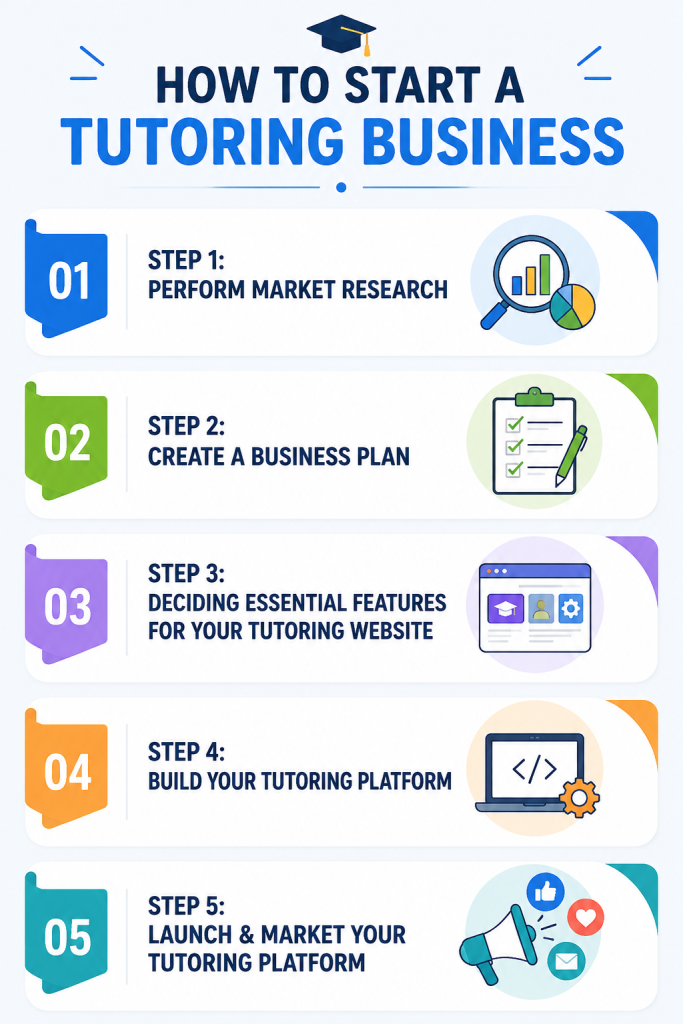
Step 1: Perform Market Research
One of the fundamental steps of starting your tutoring business is definitely market research. This involves thoroughly understanding your target market and audience.
Here’s an actionable plan for market analysis:
- Define your problem: Be sure you’re scaling your business on a relevant market problem. Ask questions like: whether there is significant market demand, how to price your services right, and advertising strategies.
- Research your audience: Understand your audience’s needs, expectations and pain points and tailor your business. Evaluate if your audience is willing to pay for your tutoring services.
- Competitor Analysis: Compare the top 4-5 competitors in your niche. Study their offerings, pricing and marketing strategies to better position your business.
Step 2: Create a Business Plan
A solid business plan covers operational flows, tutoring services, and scaling strategies. Furthermore, if you’re looking for strategic investors or business partners, having a detailed business plan ready makes it easier to get funding for your business.
Here’s a brief outline for your business plan:
- Executive Summary
- Core Problem or Opportunity
- Business Model
- Service Offerings
- Marketing Strategy
Thus, the business plan provides good clarity, profitability, and long-term stability for your business.
Step 3: Deciding Essential Features for Your Tutoring Website
The success of your tutoring platform depends on the features you build. While integrating unique features is crucial to stand out and you can’t miss out on the essential features for your tutoring platform.
Must-Have Features:
- Secure Login: Create a simple, secure and convenient login process preferably with social login and multi-factor authentication.
- Tutor Search & Discovery: Allow learners to find the right tutors through easy search and filtering options for pricing, availability, subject expertise, etc.
- Virtual Classroom: Enable real-time tutoring sessions with chat, whiteboard and interactive tools.
- Payment Integration: Integrate with Stripe, PayPal and other trusted payment providers to manage platform transactions and tutor payouts.
- Reviews & Ratings: Build trust and credibility, allowing learners to rate tutors after every completed session.
- Analytics & Reporting: Enable tutors to track student progress, engagement, earnings and peak session times to optimize teaching strategies.
- Mobile-Friendly Learning: Ensure a responsive and seamless platform access by optimizing for mobile, smartphones and tablets.
- Admin Panel: Manage business operations, bookings, active tutors and students from a single dashboard.
Step 4: Build Your Tutoring Platform
Once you have a robust foundation, it’s time to set up the technicalities of your tutoring business. A robust tutoring website needs these core technical components to deliver quality tutoring services.
Here are the five technical aspects for a running a tutoring website:
Hosting Server
Your hosting server is the digital space where all your website files, videos, user profiles, session details and payment history are stored. Choosing a trusted hosting provider is crucial, and it impacts your platform’s performance, security and uptime.
For small tutoring businesses, shared hosting is cost-effective. However, VPS hosting is recommended for growing tutoring platforms, offering complete control and better performance.
Recommended Hosting Setup:
- Popular hosting providers: – Digital Ocean / Linode / AWS EC2/ Hostinger
- Requirements: 2-core CPU, 4GB RAM, 80GB HDD is minimum
- OS: Ubuntu 22.04
Domain
Your domain name is your website address, by which users recognize your website. So, choose a short, memorable and niche-related domain name. Popular TLDs for tutoring business include .com, .edu, .org, .net, etc.
Popular Domain Providers: GoDaddy, NameCheap, Hostinger
3. Development Approach
Choosing the right development approach impacts your business performance, overall budget and long-term sustainability. The two development approaches are: custom development and ready-made solutions.
Method # 1: Custom Development
This approach involves building every feature, workflow and the complete UX design from the ground up. You need development resources, an extensive budget and to own the complete process from build to launch.
Pros:
- Tailor workflows to unique business needs and requirements
- Complete control over development and design
- High Scalability
Cons
- High development cost
- Long development & launch timeline
- Full ownership of security updates, bug fixes and continuous maintenance support
- Increased failure risk given the unexpected cost spikes and delays
Method # 2: Ready-Made Solutions
If you’re an entrepreneur planning for a quick and affordable launch, ready-made tutoring software is an ideal choice. They are pre-built solutions with all essential features and workflows to scale your tutoring and educational business. From real-time video tools to session booking and a built-in payment gateway, your entire tutoring flow is ready to deploy.
Pros:
- Affordable development budget
- Faster time-to-market
- Built-in features and functionalities reduces technical complexities
- Proven business model
- Reduced failure risk due to pre-tested features and workflows
Cons:
- Basic installation and configuration setup to streamline your business flows
Step 5: Launch & Market Your Tutoring Platform
Once you are done with business planning and feature development, it’s time for your tutoring platform to go live! Announce your platform launch on social media, emails, and educational communities.
Next, it’s time to improve your platform visibility and reach. Run promotional campaigns at places where your audience is likely to spend more time.
Some of the top marketing strategies include:
- Content marketing and search engine optimization (SEO)
- Social media marketing
- Paid ads
- Referral programs for tutors and learners
- Free trials, seasonal discounts or coupons, or educational webinars
Building a credible and trustworthy brand doesn’t happen overnight; it is an ongoing process. So, make sure you promote across multiple channels, instead of dedicating all your efforts to a single platform. Implement both organic strategies and paid advertising services for your tutoring business.
What Works in 2026: Trends, Niches, Technology, Revenue Model
1. Specialized Tutoring Business over General Tutoring Business
The global tutoring industry is competitive, with several players like Preply, Varsity Tutors, Wyzant already dominating the space. Focusing on a specific niche and target audience establishes you as the go-to expert in that niche.
Top tutoring niches to stand out in 2026:
- K-12 learning
- STEM tutoring
- Competitive exams & test preparation services
- Language learning
- Technology and coding platforms
- Career Upskilling & Professional Certification
- Homework Help & Instant Learning Support
Tutoring businesses with niche-specialization gain an edge through premium pricing, low competition, targeted marketing and enhanced trust.
2. Tutoring Trends
The online tutoring landscape in 2026 is evolving with shifting user needs, technology and skill-based training. With the growing competition, online tutoring platforms must adapt to these trends for survival and success.
Major tutoring trends shaping the industry are:
- Micro-learning
- AI-assisted learning
- Predictive analysis
- Hybrid & flexible learning models
- Mobile-first learning
- Community-based learning
Platforms that stick to traditional methods risk being left behind! Modern tutoring platforms that choose to innovate, personalize and scale their technology, fast-forward business growth.
3. Diversifying Your Revenue Streams
For tutoring businesses, diversifying revenue isn’t a strategy for business growth, it is an essential survival instinct. Reportedly, companies with diversified revenue streams are 30% more likely to achieve profitability during economic downturns. It offers business validation, operational flexibility and reduced financial risk.
Top revenue streams for tutoring businesses:
- Commissions
- Subscription-based model
- Group tutoring sessions
- Self-paced courses
- Featured Listings
Smart pricing models like pay-per-session, bundled packages (e.g., 10-session pack), and freemium models enhance the revenue opportunities further.
Related : A Guide to Two Profitable eLearning Business Models
4. Hybrid Learning Models
One-size-fits-all doesn’t work for all learners! Hence, blended or hybrid learning models are the backbone of modern learning systems. Today, parents and students look for live sessions, pre-recorded courses, cohort sessions and even occasional in-person classes.
For example, Varsity Tutors is one of the leading tutoring platforms offering both live private sessions, group tutoring, and AI collaboration tools. Few other tutoring platforms offer a mix of live and offline sessions across different subjects. And some combine live tutoring with self-paced courses for a well-rounded learning experience.
5. Trust, Safety and User Privacy are a Priority
An online tutoring platform’s reputation hinges on user trust and safety, along with its robust technology. Security is now a feature, rather than an afterthought. Tutoring platforms need to prioritize a secure infrastructure and adhere to standard privacy policies for avoiding legal pitfalls.
Key security measures for tutoring platforms:
Tutor verification & approval systems
- Streamline the tutor onboarding process by defining eligibility, verifying tutor qualifications and performing background checks.
Secure payments
- Integrate with Stripe, PayPal or other trusted payment providers to enable secure transactions. Also, craft clear payment terms and refund policies to establish financial boundaries and minimize disputes.
Data privacy compliance
- Tutoring platforms store student information such as personal details, academic records, and even session recordings. This often includes sensitive data, which needs to be protected. Comply with the global data privacy regulations such as UK GDPR (for UK-based businesses), CCPA/CPRA (for California), FERPA and COPPA and manage user data securely.
End-to-end encryption
- Encrypt chats, file sharing, and all other student encryptions to prevent third-party access. Implement end-to-end encryption for live sessions and a standard mechanism like AES for stored data.
Session recording & moderation
- Monitor live sessions with recordings and moderation tools to maintain quality standards and build safe learning environments.
What Fails in 2026: Outdated Technology, Increased Churn, Poor UX
Here are the top mistakes tutoring businesses must avoid:
1. Weak Tutor Onboarding Process
First impressions matter the most! So, what better than an effective onboarding process to keep up with your tutor’s expectations? From the interview to their first session, tutors expect a smooth transition.
But many new businesses assume that tutors will figure out everything. It results in incomplete profiles, low conversions, and high attrition.
Here’s what a streamlined tutor onboarding looks like:
- Personalised & guided onboarding
- High-quality training resources
- Easy-to-use tools, session templates for hosting live sessions
- Clear platform guidelines covering values, expectations, and boundaries
- Marketing support
2. Pricing Your Services Low
Most tutoring businesses are overwhelmed by the competitive landscape. And often they resort to underpricing or charging low commissions initially to attract new audiences. But this hurts their business profitability and long-term growth!
Instead of relying on low pricing as your USP, offer high-quality tutors, personalized learning, skill-based training, or superior user experience.
3. Poor Tutor-Student Matching & Outdated Technology
If you’re building trust and credibility with your business, tutor matching is one of the core experiences you must focus on. Learners are looking for tutors matching their specific learning style, subject needs, language and budget.
Finding the right tutor can be intimidating for students. A robust tutoring matching system matches the students to the right tutors based on their strengths, interests and learning needs. For advanced matching, integrate AI-powered recommendations, subject filters, personalized assessments, and recommendations.
4. Ignoring Mobile Optimization
Accessibility is paramount in building effective learning environments. Mobile optimization helps learners to take their lessons from anywhere, anytime, as per their convenience.
Missing out on mobile learning means reduced engagement, ineffective learning, and accessibility barriers for remote learners.
Best practices for mobile learning include:
- Responsive design
- Streamlined navigation
- Regular rounds of testing and feedback
- Incorporating alt text, keyboard navigation, and screen reader compatibility
5. Poor Engagement & Retention Strategies
Most marketplaces focus on attracting a large pool of new students, but often neglect their existing student base. But retention builds loyalty, reputation, revenue stability, and business momentum. Incorporating progress tracking, loyalty programs, gamification and personalized learning assistance improves student engagement.
Build a learning community with discussion forums, study groups, daily challenges, workshops and events. This ensures tutors feel like they belong to the community, easily share their knowledge and express ideas!
Startup Costs for Building a Tutoring Business
The startup costs for setting up a tutoring business is approximately $30,000 to $1,00,000+, depending on the feature complexity. This covers development costs, ongoing infrastructure costs, marketing, maintenance and tutor acquisition.
Here’s a complete breakdown of the development cost:
| Platform Aspect | Estimated Cost |
| Planning & Discovery | $2,000 – $5,000 |
| UI/UX Design | $10,000 – $20,000 |
| Development Costs | $20,000 – $35,000 |
| Testing & Launch | $5,000 – $10,000 |
| Core Infrastructure Costs | $20,000 – $40,000 |
| Marketing & Promotion Expenses | $5,000 – $7,000 |
| Tutor Acquisition & Onboarding | $1,000 – $5,000 |
Ongoing infrastructure costs include hosting, cloud services, video integrations, payment gateway fees, analytics, etc. This costs you recurring monthly or annual expenses, often overlooked by tutoring businesses while planning their initial budget.
Tutoring Platform Costs Based on Development Approach
| Cost Category | Custom Development | Ready-made Tutoring Softwares |
| Development Cost | $30,000 – $1,00,000+ | $700 to 1500 (For MVP Platform) |
| Customization Cost | –
(Included in development cost) |
$149 – $999 (Depending on the customization) |
| Maintenance & Support Cost | $1000 – $3500 per year approximately | Free for first year; $999 support opt-in later on |
| Hosting Cost | $42 – $150 per month | $42 – $150 per month |
| Total Cost of Ownership | High | Low |
Key Factors Impacting Tutoring Business Costs:
- Feature complexity
- Tech stack
- Development rates & team structure
- Testing & maintenance
- Customization & third-party integrations
- Web or mobile launch
- Security & compliance
How Pinlearn Can Help to Launch a Tutoring Business?
The traditional custom development approach requires reinventing the wheel or managing multiple tools. While this is feasible initially when your platform is small, once your business grows, it’s challenging. That’s where a pre-built tutoring software like Pinlearn comes in!
Now, you have a powerful foundation ready, all you need to do is choose your revenue model and tweak a few customizations! An integrated tutoring software like Pinlearn is a complete package: offering virtual classrooms, booking systems, built-in payment gateways, analytics and marketing tools, out-of-the-box.
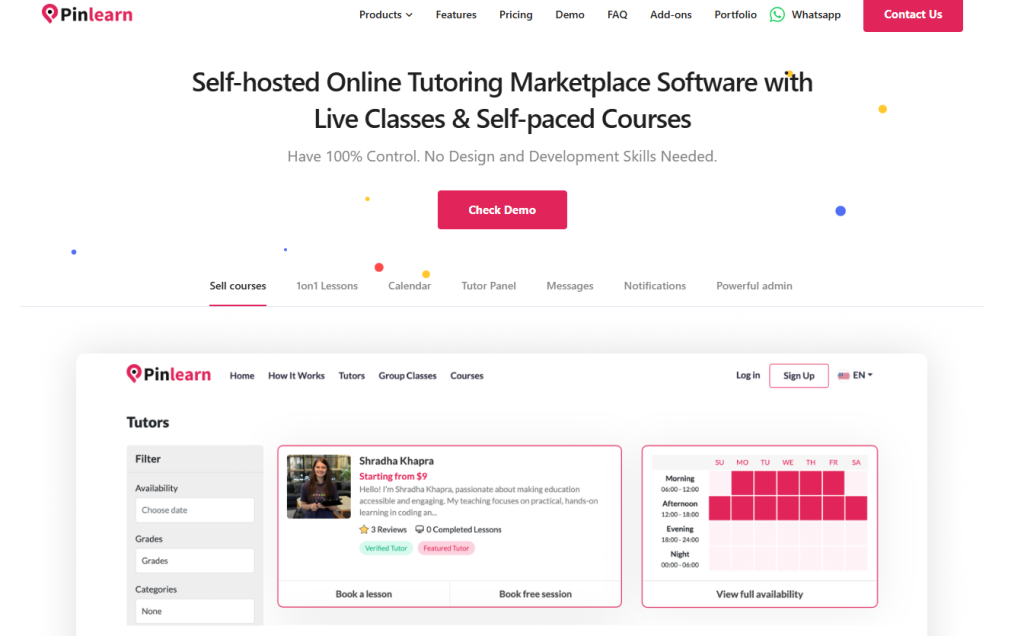
Key Benefits of Pinlearn:
- Feature-rich & user-friendly design
- 100% customizable and white-labeled software
- Scalability & GDPR-compliant
- Diverse monetization streams to expand your revenue
- Comprehensive admin panel to manage business, third-party tools, platform settings and more.
- Marketing tools like promo codes, SEO integrations, analytics tracking and referral programs
Legal Requirements to Start Your Tutoring Business
For legal and regulatory compliance, align your business with state and federal requirements to avoid bans and penalties.
Here’s a list of legal requirements for tutoring business:
- Business Structure: Choose from a sole proprietorship, a Limited Liability Company (LLC) or a Corporation for starting a tutoring business. Solo Proprietorship is suitable for small businesses, but comes with unlimited business liability. An LLC is recommended for asset protection and tax flexibility.
- Business Licensing & Registration: Tutoring businesses need to obtain a license based on where they operate. Check the local regulations on whether you require a business license or a home occupation permit to stay compliant.
- Insurance Compliance: General Liability Insurance covers accidents, injuries or property damages during sessions. Professional liability insurance provides coverage that protects you from negligence claims or settlement costs.
- Data Privacy Compliance: Ensure your privacy and security frameworks comply with global privacy standards such as GDPR for EU-based businesses, state laws like CCPA and FERPA (school-related records) for US-based businesses.
- Payment Compliance: To build trust and safe payment systems, ensure you integrate with trusted payment gateways, adhere to the PSS-DSS standards, and comply with KYC / AML regulations.
- Intellectual Property Protection: Different content types require unique levels of protection. For example, copyright applies to written text, while a trademark protects your brand name, logos and taglines. DRM controls ensure authorized access and ownership of your platform content.
Conclusion
Starting a tutoring business is definitely profitable in 2026; however, you need to keep an eye on ongoing trends and avoid expensive business mistakes most entrepreneurs make. Don’t just focus on core functionalities, but define a unique business proposition and plan for long-term scalability. Lastly, don’t overlook the legal and compliance complexities of establishing a business.
If you’re new to the tutoring industry or navigating through multi-faceted business aspects seem overwhelming, Pinlearn can help you!. With over 10 years of experience in building successful tutoring and educational businesses, our skilled team can guide you at every step. Pinlearn offers a pre-built tutoring software with video APi, booking, and built-in marketing flows, so you can focus on growing your business!
FAQ-Related to How to Start a Tutoring Business
1. Is licensing essential to start a tutoring business?
You don’t need a teaching or educational license to start a tutoring business. However, if you’re partnering with organizations or offering accredited programs, you need a valid educational license. Besides that, a valid business structure registration and adherence to the data protection laws and payment standards is crucial.
2. How to start a tutoring business online?
To start with an online tutoring business, choose a profitable niche, research the market, identify the revenue model, choose the development approach and finally launch and promote your website.
3. Is the tutoring business profitable?
Yes, the tutoring business is highly profitable due to the growing market demand, low setup cost, skill-based learning, global reach and flexibility.
4. What is the cost of starting a tutoring business?
The cost to launch a tutoring business ranges from $30,000 to $150,000+. This also includes ongoing costs like hosting, third-party tools, tutor recruitment, maintenance, and marketing.
5. How long does it take to build a tutoring platform?
Building a tutoring platform from scratch takes around 4 to 12 months, depending on the feature complexity. Ready-made tutoring software like Pinlearn can lower the project timeline to 5-6 days, ideal for entrepreneurs and startups.