How Much Does It Cost to Build an LMS? Pre-Built vs Custom Cost Comparison Explained

TL;DR
- Custom built LMS platforms cost anywhere between $20,000 to $2,50,000+ approximately, while pre-built LMS clone scripts help you to launch an MVP within a $1499 budget.
- Pre-built white-label LMS clone scripts are a smart approach to build fully-fledged, customizable and branded LMS at significantly lower costs.
- Hidden development expenses include monthly hosting costs, third-party API tools, support and licensing fees, which adds $8000 – $10,000 annually.
Are you looking to switch from renting an LMS platform to owning one? Or, probably, you’re planning to build your LMS from scratch? Then, costs might be one of the biggest roadblocks in your development process.
In order to plan a clear budget for building your LMS, you must calculate “how much does it cost to build an LMS?” Having been in this industry for the past decade, we have observed that businesses often overlook scalability, ongoing costs, API and maintenance fees. That’s what led us to write this detailed cost guide!
Here, we provide a complete feature breakdown, list the high-impact cost factors, and also offer some practical wisdom to avoid budget overruns.
How Much Does it Cost to Build an LMS?
The cost of developing an LMS ranges from $20,000 to $2,50,000+ approximately, depending on the platform complexity. Estimating the development costs by considering different factors helps in effective planning of budget and resource allocation.
LMS Cost Analysis Based on Development Phases (For Custom Development)
| Development Phases | Estimated Cost | Timeline |
| Discovery & Planning | $2,000 – $5,000 | 1 – 3 weeks |
| UI/UX Design | $10,000 – $20,000 | 2 – 6 weeks |
| Development | $20,000 – $35,000 | 4 – 12 weeks |
| Testing & QA | $5,000 – $10,000 | 2 – 4 weeks |
| Launch & Deployment | $2,000 – $5,000 | 1 – 2 weeks |
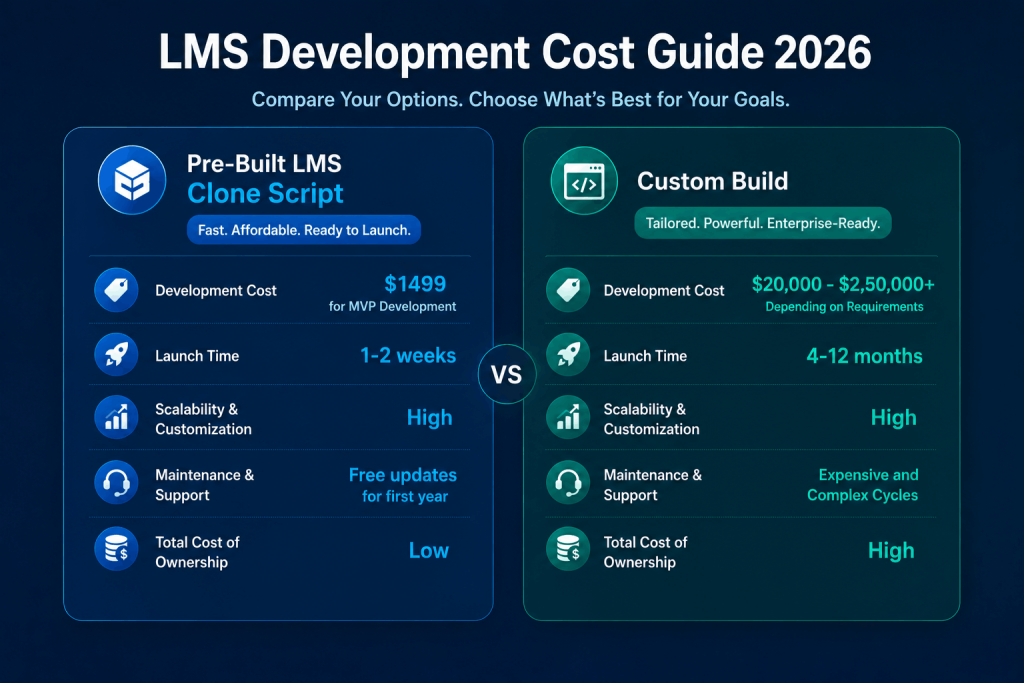
If you are planning for an early and affordable launch, pre-built LMS clone scripts can help you! You get a ready-to-deploy LMS which can be tailored to your business needs and launched at a fraction of the original cost.
Custom Development vs. Pre-Built LMS Clone Scripts: Cost Comparison
Here’s a quick cost comparison to help you make the best development decision:
| Cost Category | Custom LMS Development | Pre-Built LMS |
| Development Cost | $20,000 – $2,50,000+ | $1499 (For MVP Platform) |
| Customization Cost | –
(Included in development cost) |
$149 – $999 (Depending on the customization) |
| Maintenance & Support Cost | $1000 – $3500 per year approximately | Free for first year; $999 support opt-in later on |
| Hosting Cost | $42 – $150 per month | $42 – $150 per month |
| Total Cost of Ownership | High | Low |
LMS Cost Breakdown: Key Features and Functionalities
Now we have discussed the overall cost based on development phases. For deeper analysis, let’s look into the cost of developing every feature.
| Features | Estimated Development Cost ($40/ hour) | Development Timeline |
| Login & Authentication | $8000 – $9,600 | 5 – 6 weeks |
| Course Creation & Management | $4800 – $6400 | 3 – 4 weeks |
| Video Streaming | $3,200 – $9,600 | 2- 6 weeks |
| Progress Tracking | $2400 – $3600 | 2 – 3 weeks |
| Quiz & Assessment Module | $3,200 – $6400 | 2- 4 weeks |
| Gamification | $3200 | 2 weeks |
| Certificate Generation | $2400 – $3600 | 2 – 3 weeks |
| Payment Gateway Integration | $3200 | 2 weeks |
| Admin Panel | $9600 – $12,800 | 6 – 8 weeks |
| Security & Compliance | $3600 – $4800 | 3 – 4 weeks |
| AI Features (Advanced Features) | $6,400 – $10,000 | 4-6 weeks |
| Total Development Cost | $50,000 – 73,200 (Mid-level Complexity) | 4 – 6 months |
1. Login & Authentication
Design a simple and intuitive login along with role-based access that verifies the user’s identity and grants specific permissions and controls. Security features like SSO, multi-factor authentication, and social logins are common authentication methods that tend to increase development costs.
- Cost: $8000 – $9,600
- Timeline: 5 – 6 weeks
2. Course Creation & Management
One of the most essential features of learner management systems is to structure and deliver learning resources. An LMS with robust course management software allows to create, manage, track as per learner’s needs.
The course management system needs to be SCORM-compliant for creating and hosting content. Ensure your LMS supports slides, videos, audio clips, quizzes, and other learning materials for well-rounded learning.
- Cost: $8000 – $9,600
- Timeline: 5 – 6 weeks
3. Video Streaming
It helps instructors to deliver learning resources through pre-recorded videos, live classes, and even interactive training sessions. Allow instructors to upload large video files on course topics, which learners can access at their convenience.
Third-party sites like Vimeo and YouTube reduce infrastructure overhead and scalability challenges. Modern LMS integrates with video conferencing tools like Zoom, MS Teams, LessonSpace and GoToWebinar to build an effective virtual environment.
- Cost: $3,200 – $9,600
- Timeline: 2- 6 weeks
4. Gamification
If you think learning is boring, gamification will make you rethink! Much like video games, points, badges, quests, leaderboards, and rewards make learning fun. Of course, these features also boost learner engagement, retention, and help to meet learning goals.
- Cost: $3200
- Timeline: 5 – 6 weeks
5. Quiz & Assessments
After the fun element comes the part which puts all of the learning to the test! Assessments or quiz modules at the end of every lesson ensure learners recall concepts and complete their course or training satisfactorily. Multiple-choice questions, true/false assessments, and short-answer fill-in-the-blank are different assessment types.
- Cost: $3,200 – $6400
- Timeline: 2- 4 weeks
6. Certificate Generation
This module of LMS generates custom certificates on successfully completing a course module. Most LMS platforms use a custom plugin for certificate generation. You just design the certificate template and the LMS generates a downloadable certificate automatically.
- Cost: $2400 – $3600
- Timeline: 2-3 weeks
7. Progress Tracking
Knowing how far learners have progressed in their course goes a long way toward motivating them. Most LMSs use progress bars and visual trackers to show performance insights and even missed milestones.
- Cost: $8000 – $9,600
- Timeline: 5 – 6 weeks
8. Payment Gateway
Integration with a payment gateway helps to process course payments, subscriptions and certifications. Stripe, PayPal, Square, and Authorize.net enable secure transactions and support multiple payment methods like credit/ debit cards, wallets, and even installments through BNPL services.
- Cost: $3200
- Timeline: 2 weeks
9. Admin Panel & Analytics
A centralized panel helps admin to moderate courses, track student progress, manage instructors and optimize revenue from a single place. Your LMS should seamlessly integrate with video conferencing tools, payment gateways, e-commerce tools and more. A powerful LMS generates custom reports to measure key LMS metrics such as enrollments, course performance and revenue.
- Cost: $9600 – $12,800
- Timeline: 6 – 8 weeks
10. AI Features
AI-assisted learning could be a game-changer for your LMS! You can introduce content recommendations, auto-course creation, or even predictive analytics. This helps to personalize learning paths, speed up course creation, and reduce administrative burden.
- Cost: $6,400 – $10,000
- Timeline: 4-6 weeks
Factors Affecting the LMS Development Cost
While we can provide a rough estimate of the development cost, the actual cost is influenced by several factors. Everything from project complexity to technologies and customizations could drive your costs up or down.
1. LMS Complexity
Your LMS platform’s features and functionalities are one of the most significant factors determining the development cost. The more complex the features are, the higher the development cost. Every additional feature needs to be designed, developed and tested. Hence, start with MVP features and later scale on the advanced features once you attract users.
| LMS Complexity | Development Cost | Development Timeline |
| Basic LMS
(Login, Course Management, Video Lessons) |
$20,000 to $40,000 | 3 – 4 months |
| Medium Complexity (Payment Gateway, Quizzes, Analytics) | $50,000 to $70,000 | 4 – 6 months |
| Advanced LMS
(AI Features, Gamification, Integrations) |
$80,000 to $1,20,000+ | 8 – 12 months |
| Enterprise LMS (Mult-Tenancy, Compliance Tracking, Integration, Custom Branding, White-Labeling) | $1,50,000 – $2,50,000+ | 12 – 18+ months |
2. Tech Stack
Your tech stack varies depending on your operational, scalability, and timeline requirements. The frontend, backend, and database technologies you choose decide your LMS performance and business growth. While popular technologies such as React or Node.js speed up development, they require skilled developers, adding to the overall cost.
Similarly, building a scalable LMS means integrating load balancers and CDNs to handle huge traffic spikes which further increases your LMS cost.
3. Development Rates & Team Structure
Developer fees vary based on your team’s location and team size. Hiring developers from North America and Western Europe costs more than hiring from Eastern Europe and Asia.
| Country/Region | Hourly Development Rate |
| North America | $65 – $100 |
| Latin America | $50 – $70 |
| Western Europe | $55 – $80 |
| Eastern Europe | $40 – $60 |
| South Asia | $20 – $50 |
Further team size and structure are other essential cost factors. A large team, including developers, UI/UX designers, testers, and project managers, reduces the development cost but influences the hourly rates.
4. Platform Type
Building a web app is cheaper than mobile apps that need native iOS and Android support. Mobile app development requires building two separate apps for iOS and Android, increasing the development time and cost. However, cross-platform technologies like Flutter and React Native significantly cut down the cost as you need a single codebase for both platforms.
5. Customization & Integrations
Modern learners and corporate organizations need connected learning systems. Standalone LMS applications offer limited personalization and flexibility, which aren’t suitable for adaptive learning experiences. Today, LMS needs to be integrated with collaboration platforms, communication tools, video conferencing tools, project management systems and more.
Building integrated workflows that streamline the entire LMS workflow demands a high level of customization. Additionally, white-labeling, reporting and analytics also influence the development cost.
6. Security & Compliance
In this era of cyber threats, LMS security and user privacy are paramount. It helps to safeguard user privacy, protect sensitive data, and build stakeholder trust. However, implementing user authentication, data encryption, and adhering to compliance regulations definitely increases development costs.
Further, your LMS must adhere to data protection laws and WCAG accessibility standards to ensure secure data storage and management.
Pre-Built LMS vs Custom Development: Detailed Comparison
The development approach you choose determines the long-term success of your platform. Imagine laying a strong foundation for your building. If the foundation isn’t rock-solid, no matter how high-quality the building materials are, the structure would eventually collapse.
Hence, this is the most fundamental step. It impacts your LMS scalability, performance and even budget. Businesses can choose from two options: pre-built LMS clone scripts or custom development.
Pre-Built LMS
Pre-built LMS scripts are ready-to-deploy, cost-effective, and include all essential LMS features and functionalities. It offers everything from course management to built-in payment gateways and dashboards, to quickly roll out your learning platform. The most significant advantage here is faster time-to-market: launch within weeks rather than months.
Best for: Entrepreneurs and startups seeking a quick and affordable solution
Pros
- Speed-to-market advantage
- Cost-effective
- Pre-tested and low failure risk
- Vendor-supported maintenance & upgrade cycles.
- White-labeling features & branding control
Cons
- Initial Setup and Configuration guided by clone script providers
- Not suitable for legacy systems or highly unique business requirements
Custom Development
The traditional custom development approach requires you to build all the LMS features from scratch. While this takes a long time and a higher budget, it offers complete control over functionality and implementation. But imagine the challenges and overhead costs you need to endure as new entrepreneurs. Also evaluate the technical debt, regression testing and refactoring costs. Thus, the actual cost exceeds the estimated budget.
Pros
- Tailored functionality
- High customization & scalability
- No platform lock-in
- Enhanced privacy & security
Cons
- High development costs
- Longer development cycles & project delays
- Complex maintenance & support process
Hidden Ongoing Costs that Kill Budgets After Launch
Apart from the development costs, there are few ongoing expenses for smooth business operations.
Below are the ongoing costs that most LMS businesses overlook:
1. Hosting & Video Storage Costs
Platform owners have to pay a recurring fee for hosting and storage servers. VPS and cloud hosting are recommended for platforms with moderate traffic, but it is more expensive than shared hosting.
- Costs: $ 42 – $150 monthly
Expert Tip: AWS, DigitalOcean, Linode and Hostinger are recommended hosting providers. Typically, VPS hosting requires 4 vCPUs, 8GB RAM, 100GB SSD and the Ubuntu 22.04 LTS operating system.
2. Third-Party API Fees
APIs for video streaming, payments, authentication, analytics, etc., might cost a monthly subscription.
- Costs: Varies depending on the number of third-party integrations
3. Maintenance and Updates
Regular bug fixes, troubleshooting, software upgrades and technical support incur an annual cost. For pre-built LMS clone scripts, this is typically handled by vendors and is free for the first six months to one year.
- Costs: $5,000 – $7,000 annually
Tips to Reduce LMS Development Costs
Let’s discuss some practical strategies to save on the development costs!
- Launch an MVP initially: Build an MVP with core LMS features and workflows first, then integrate advanced features later. This offers enough time to validate your idea and gather early feedback.
- Use pre-built LMS clone scripts: If you don’t want to waste your time and efforts on building from scratch, use ready-made LMS clone scripts. You get a proven model minimizing the failure risks.
- Define a clear product roadmap: Effective development planning and ownership reduce delays and unexpected costs later.
- Plan a scalable architecture: Build your LMS architecture with a growth mindset, even if scalability seems far off. Choose technologies and frameworks that support scaling, to avoid rebuilding the entire LMS later.
Conclusion
Estimating the LMS development cost is challenging, considering the multiple factors impacting the final price. By following this guide, you’ll be able to estimate LMS cost more accurately. However, it’s crucial to consider the learning objectives and target audience before you start with the calculation.
One of the easiest ways to reduce development costs is to choose pre-built LMS clone scripts. We have seen how businesses launch early, scale easily and double their revenue by making a simple decision. Build with us to be one among this growing clan of successful businesses!
FAQs-Related to How Much Does It Cost to Build an LMS
1. How much does it cost to build a custom LMS?
The cost to develop a custom LMS ranges from $20,000 to $ 2,50,000+ approximately, depending on project complexity, tech stack, and customizations.
2. What is the timeline for building an LMS?
LMS custom development takes 4-12 months, while pre-built LMS clone scripts like Pinlearn can be launched within 1-2 weeks.
3. Can I build an LMS with pre-built clone scripts?
Yes, you can build an LMS platform using pre-built clone scripts within 1-2 weeks at a fraction of the development cost.
4. Is it cheaper to build or buy an LMS?
Pre-built LMS clone scripts are significantly cheaper than building a custom LMS from scratch.
5. How do I choose the right development partner to build my LMS?
Evaluate LMS providers for core features, user-friendly design, integration, scalability, post-launch support and maintenance.