
How to Create a Language Learning Website: A Complete Guide
TL;DR
- The language learning industry is rapidly expanding due to growing demand for multilingual skills driven by globalization, upskilling, migration, and travel.
- To start a language learning platform, define a profitable niche, perform market research, pick a business model, decide the core features, choose the right development technology, launch and market your website.
- Scale on a regional or underserved language niche, rather than as a generic language marketplace.
- A custom-built language learning platform costs $40,000 to $150,000+ approximately. Ready-made, white-label tutoring solutions lower the cost to $700 to $1500 for MVP development.
Learning a new language has never been more convenient and engaging before, thanks to the growing number of language learning apps. From Duolingo’s streak spree to Babbel’s bite-sized lessons, learners today can master a language in a fun, engaging and practical way.
While there are several language learning platforms, there still exist potential industry gaps. Conversational fluency, limited support for regional languages, poor retention and no industry-specific language training are some key areas worth scaling on.
Launching a language learning platform requires you to overcome the initial roadblocks through a successful plan, which is what you’ll find in this blog. So, let’s get started!
Language Learning Market: Key Players, Market Size, Growth Drivers, Key Trends
The global language learning industry is valued at $24.39 billion in 2026 and projected to reach $50.82 billion by 2031, growing at a CAGR of 15.83% during this period.
Here are some key statistics shaping the language learning industry today:
- English tops the list of most learned languages around the globe. Spanish, French, Mandarin Chinese, German and Japanese are other popular languages.
- Asia-Pacific is the fastest growing language learning market, driven by smartphone penetration, English learning and government support.
- North America holds 36% of the language learning market, with the United States in the forefront. Europe and China are other significant language learning markets.
- Duolingo, Busuu, Babbel, Preply, Rosetta Stone, Italki and Lingoda hold the largest language learning market share and dominate the industry trends.
- Global business operations, international education, travel, AI advancements and interactive learning are key growth drivers.
Language Learning Trends
- Massive demand for multilingual skills fueled by globalization.
- Self-learning apps offer accessible, gamified and mobile-based learning experiences.
- AI-powered platforms aid personalization, real-time feedback, and learner engagement.
- AR and VR simulations bring in real-world learning experiences.
- Data-driven insights tailor learning paths to individual needs and outcomes.
Step-by-Step Guide to Building a Language Learning Website
Whether you’re a language expert or an entrepreneur, the language learning industry is a resounding opportunity. The impressive industry stats speak for themselves! However, to compete with the likes of Duolingo, Babbel, Preply and Italki, you need a unique business idea, an innovative revenue model and powerful technology that fits your platform goals.
Here’s a complete end-to-end roadmap that guides you through initial planning to deployment:
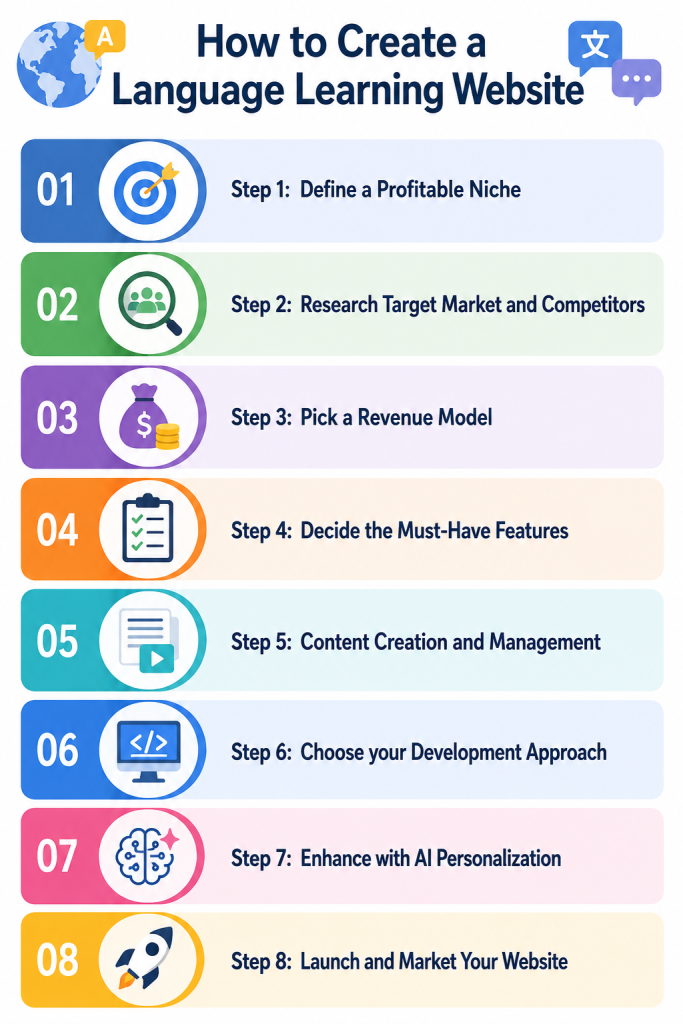
Step 1: Define a Profitable Niche
Before you start development, choose a niche market and target audience. The language learning industry is competitive, with many strong players like Preply, Italki, and Verbling.
So, question yourself: why should learners choose your platform, and what makes it unique?
For example, you could target a specific:
- Language offering or services (e.g., Regional or emerging languages, Business English, travel conversation, exam preparation (TOEFL/IELTS))
- Audience segment ( Professionals, school-going kids, expats or travellers)
- Proficiency (Beginners, advanced, or both)
- Pain points (lack of personalized learning, no qualified tutors or native speakers, limited exposure to practical conversations and examples)
⚡Pro Tip: Look beyond generic language-learning options and explore underserved language offerings like Swahili, Cebuano and Tagalog. Find a native speaker and build high-quality, localized audio/video content and learning resources. Add actual conversational scenarios, practice tests, and gamified lessons to make it interactive.
Step 2: Research Target Market and Competitors
Analyze the top competitors and regional players. Also, keep an eye on industry trends such as bite-sized learning, gamified lessons and mobile learning.
Understanding competitor strategies helps to position your platform better with superior UX, high-quality content and the right pricing.
Evaluate top competitors for:
- Language offerings & services
- Target audience
- Learning mode (Live tutoring, self-paced or hybrid)
- Pricing plan
- Tutor network & expertise
- Marketing strategy
- AI adoption
To stay competitive, make sure you scale on the platform gaps and evolving trends. Also, check customer reviews on third-party websites such as TrustPilot, G2, Capterra, etc. Be it software glitches, customer support issues, or a price mismatch, every drawback is an opportunity to push your software through!
Step 3: Pick a Revenue Model
Next, it’s time to pick an innovative revenue model to boost the profitability of your language learning platform. Choose the right revenue model that fits your product, platform goals, and customers.
Here are the different ways to monetize your language learning app:
- Commission-Based Model – Platform earns fixed commissions based on the total hours taught. A standard commission percentage of 10% – 30% is ideal for language learning platforms.
Examples: Preply, Italki, and Verbling
- Pay-Per-Session Model – Charging for individual live sessions or lesson packages is one of the most common revenue models. Students can take up trial lessons, once satisfied, they can purchase paid lessons or lesson packages.
Examples: Preply, Italki
- Subscription Tiers – If you’re looking for recurring revenue, take inspiration from subscription-based platforms like Babbel, Busuu and Duolingo. Users can purchase monthly or annual plans and access language courses, practice tests, exercises, progress tracking, certifications, etc.
Examples: Rosetta Stone, Memrise
- Freemium Models – It is one of the most widely implemented revenue models. The freemium model attracts free users with basic features, while nudging them for full course access, advanced tools, or personalized learning paths over time.
Examples : Babbel, Duolingo
- Partnerships – Collaborate with corporates (for language training), universities, or schools (curriculum integration or certification) to expand your revenue.
Examples: Duolingo, Busuu, Babbel
Step 4: Decide the Must-Have Features
A modern, feature-rich platform attracts the right user base and provides an effortless language learning experience. Ensure you choose the right mix of essential and advanced features for students, tutors and admin.
Here are the must-have features for a language learning website:
- Login & Registration – Create a simple and secure login process for students and tutors. Collect learner goals, proficiency level and preferences for a more personalized onboarding experience.
- Course Management – Offer an easy, user-friendly course management interface for tutors to upload and organize lesson plans, videos, quizzes and practice tests.
- Live Video Lessons – Integrate with video conferencing SDKs like Zoom, LessonSpace, Zegocloud for building a live virtual classroom environment.
- Tutor Booking System – Learners can self-schedule demo or paid lessons with specific tutors based on their availability and make payments instantly.
- Ratings & Reviews – Allow students to rate their learning experience, enhancing tutor credibility and helping new users to find the right tutors.
- Payment Gateway Integration- Streamline payments with Stripe and PayPal gateways that support automated revenue splits and recurring subscriptions.
- Communication Tools – Include chats, learning assistants, emails and forums for better student-tutor communication.
- Multilingual support – Provide localized UI (translate microprompts, messages, notifications in local languages), courses in multiple languages and AI translations for global reach.
- Interactive Features – Incorporate quizzes, multiple-choice questions, reading samples, etc., to improve engagement.
- Analytics and Reporting – Help students track time spent on tasks (e.g., reading, speaking, writing), active streaks, accuracy, vocabulary, etc. Allow educators to track learner progress, predictive analytics, earnings,etc.
- Admin Panel – A centralized admin dashboard helps to manage students, tutors, content and business analytics.
Step 5: Content Creation and Management
Your platform’s content reflects your expertise, credibility and builds trust. So, collaborate with the right subject matter experts to build a comprehensive, yet engaging curriculum.
Here are key points for curating your platform’s content:
- Storytelling – Teaching a language isn’t just about grammar and vocabulary. Weave in compelling stories, intriguing roleplay scenarios and anecdotes to captivate your audience.
- Multimedia Content – Enrich your content with videos, audio clips, articles and podcasts for a well-rounded learning experience.
- Gamification – Streaks, challenges, badges, and leaderboards keep the thrill alive and motivate learners to meet their goals.
- Cultural Sensitivity – Be respectful and aware of cultural context while crafting every piece of content. An inclusive curriculum creates a safe, nurturing environment for learners from diverse backgrounds.
Step 6: Choose your Development Approach
The development technology you choose lays a solid foundation for your language learning website. It determines everything from language learning experience to scalability, development cost, launch timeline, and level of customization. This is a game-changing step for entrepreneurs, so invest some time for research.
The two popular development approaches are:
1. Custom Development
This approach is ideal for building a tailored learning platform where you develop all the features and flows from the ground up. While it offers complete control over design and development, it costs you a significant budget and takes over months of development.
2. Ready-Made Solutions
The second one is a cost-effective and a more practical approach ideal for entrepreneurs launching early to validate their idea. They get ready-to-deploy software with all essential features, including course management, dashboards, live video integration and payment integration. Despite the pre-built framework, businesses can customize the workflows, tweak the UX or add new integrations to suit their needs.
| Comparison Aspect | Custom Development | Ready-made Solutions |
| Launch Time | 4 to 12 months | 1 to 2 weeks |
| Development Cost | $30,000 to $150,000+ | $700 to $1500 (For MVP Development) |
| Customization | High | High |
| Scalability | High | High |
| Maintenance & Update Costs | Expensive & complex cycles | Lower maintenance cost; at least 1 year free support provided by vendor |
| Technical Risk | High (Reinventing the wheel) | Low (Pre-tested features and flows) |
Step 7: Enhance with AI Personalization
Hyper-personalization has evolved from a mere trend to the future of language learning. AI has radically transformed how learners grasp a new language at the fundamental level.
Here’s how AI flows are impacting language learning for better:
- Adaptive Learning: AI assesses learners’ strengths and weaknesses and adjusts the pace of learning to the learner’s style and needs. It offers additional resources or exercises to improve on the topics where they need help.
- Real-Time Feedback: AI assistants provide instant feedback on pronunciations, assignments, vocabulary, and grammar. This reduces reliance on teachers and speeds up overall learning process
- Automated Grading and Assessments: AI-powered tests based on learners’ needs and capabilities reduce the burden on educators. Also, automated grading systems evaluate students’ essays, quizzes and assignments with predefined rubrics. This frees up more time for educators to take up other important tasks, such as lesson planning and ideation.
- Content Recommendations: AI can suggest videos, exercises, or resources to include in your courses. This is based on the learner’s proficiency level or style, curating a personalized learning experience.
Step 8: Launch and Market Your Website
Once you’re done with development and setting up a solid tutor network and content, it’s time for your website to hit the ground! It’s rightly said, ”Go big, or go back home!” This applies to marketing as well; so build your online presence across multiple marketing channels.
Here are some effective marketing strategies:
- Social media campaigns – Create short-form videos, post language tips, funny language memes on Instagram Reels, Facebook, or viral TikTok videos.
- Paid Ads – Run advertising campaigns on social media targeting travel, immigration, and career development segments.
- SEO – Optimize your website for long-tail keywords like “best online business english courses for professionals” and create a content hub with how-to-guides, language tips, or travel advice.
- Email marketing – Send emails with short language courses, weekly newsletters, and attractive discounts.
- Partnerships – Collaborate with niche influencers and bloggers in the education niche.
- YouTube Marketing – Create your YouTube channel teaching basic language lessons, language tips, common mistakes and pronunciation videos. This way, you can attract organic traffic to your language website.
Exploring ways to build your brand’s online presence? Here’s our in-depth guide covering top promotional strategies for e-learning platforms.
How Much Does it Cost to Build a Language Learning Platform?
Cost is a crucial roadblock in the software development process. The development cost for building a language learning platform ranges from $40,000 to $150,000+ approximately. Ready-made solutions like Pinlearn start at a much lower cost of $699 (for the MVP platform) compared to custom development.
Custom Development Cost: Complete Feature Breakdown
| Platform Feature | Development Time | Cost Estimate($40 per hour) |
| Login & Registration | 5-6 weeks | $8000- $9600 |
| Basic Search & Filtering | 2 weeks | $3200 |
| Payment Gateway Integration | 2 weeks | $3200 |
| Book System & Calendar Management | 5-6 weeks | $8000 -$9600 |
| Reviews & Ratings | 2 weeks | $3200 |
| Real-time Video Conferencing | 3-4 weeks | $4800 – $6400 |
| Dashboard & Analytics | 6-8 weeks | $9600 – $12800 |
| Messaging | 8 weeks | $12,800 |
| Interactive Features | 2 weeks | $3200 |
| Total Development Cost | 4 – 12 months | $56,000 – 64,000 (Medium-Level Complexity) |
With Pinlearn, you get all these features pre-built into the base product, so you can launch early and validate your business idea. While we handle the technical part, you can dedicate your efforts towards marketing and scaling your business.
Factors Impacting the Final Development Cost
- Feature Complexity
- UI/UX Design
- Customizations & Integrations
- Development Rates & Team Location
- Development Approach
- Platform Type
Why Now is the Perfect Time for Language Learning Websites?
Starting a language learning platform is an empowering idea in an era of digitalization and cross-border communication. By bridging learners with language experts, you efface the language divide and build a powerful stage for the expansion of ideas, knowledge and experiences.
Here are a few compelling reasons to build your dream language learning business:
- Globalization: Corporate language training and upskilling are one of the biggest catalysts for the language learning industry’s unprecedented growth. Knowing a local language has become an effective tool for business expansion and international collaborations.
- Underserved Niches: Although the language industry is booming, there still exists a huge market demand for regional languages like Swahili, Cebuano, etc.
- Global Migration and Travel: Workforce migration or leisure travel has created a massive demand for learning foreign or regional languages.
- Technology & Immersive Experiences: Further, AI technology fuels adaptive learning paths, real-time feedback, and automated flows, ensuring a dynamic and interactive learning process.
Build Your Language Learning Website Today
Language learning is a fast-growing industry and a massive business opportunity for entrepreneurs. With a niche language platform, you’re not just building a profitable business, but an engaging community where learners thrive together. This guide covers all the developmental steps from initial market research to final launch, for rolling out a successful language learning platform.
If you’re overwhelmed with the technical complexities, we at Pinlearn can help you! Our ready-made clone script comes with course management, live classrooms, built-in payment integration, and dashboards to skip building from scratch.
Book a quick 15-min discovery call with our team to discuss how Pinlearn can help you launch a thriving language learning website!
Further Reading:
FAQ-Related to How to Create a Language Learning Website
1. Which technologies are suitable for building language learning websites?
Use React, Next.js, Vue.js for front-end, for backend Python-Django, Fast API is recommended. Popular databases include PostgreSQL and MongoDB.
2. How can you improve user retention in language learning websites?
Effective techniques to improve language learning include streaks, badges, daily goals, challenges, pronunciation feedback and learning assistants.
3. How can language learning websites make money?
Language learning websites monetize from freemium models, subscription packages, advertising, practice tests, certifications and corporate training programs.
4. How long does it take to build language learning websites?
Custom development takes 4 to 12 months, depending on feature complexity. Ready-made solutions help to launch your language learning platform within 1-2 weeks.
5. How much does it cost to build a language learning website?
Custom-built language learning platforms cost $40,000 to 150,000+ approximately. Cost depends on factors such as features, tech stack, hourly rates, location, integrations and customizations impact the final cost. Ready-made clone scripts lower the cost to $700 to $1500 for MVP platform.