

How to Build an Online Legal Consultation Platform at Affordable Cost?
TL;DR
- To build an affordable legal consultation platform, start with market research, competitor analysis, and choose a sustainable revenue model.
- Commissions, subscriptions, video consultations, document review services, and featured listings are top revenue streams for a highly scalable marketplace model.
- Ensure compliance with lawyer verification, payment regulations, data protection laws, and clear refund policies.
- For entrepreneurs and startups, white-label consultation software helps to launch a fully functional legal consultation platform within 1-2 weeks rather than months.
- Custom development costs range from $40,000 to $2,00,000+, while white-label clone scripts scale down the launch budget to $699 to $1500.
The legal industry is continuously evolving thanks to regulatory pressure, changing client relationship dynamics, and advancements in technology. At the same time, quicker dispute resolution and broader justice access is the need-of-the-hour. 68% of law firms struggle with fee collection, despite all the work they’ve put in. These challenges have made legal firms and businesses rethink the entire process.
Virtual consultation platforms are transforming how clients access legal services. Video consultations, speedy document services, and virtual contract reviews minimize the geographical barriers and friction costs. If you’re a legal expert with years of experience, you can launch a virtual consultation platform, streamline client interactions and serve more clients.
This comprehensive guide explores how to build an online legal consultation platform, covering its profitability, development costs, and the most cost-effective approach to launching your consultation business.
Are Online Legal Consultation Platforms Profitable?
Here’s why turning your legal expertise into online business is a strategic investment:
1. The Legal Service Industry is Rapidly Growing
The global legal service industry is valued at $1.08 trillion in 2026 and projected to reach $1.50 trillion by 2032. The growing need for regulatory compliance, adoption of legal technology, and rising disputes have catalyzed a massive demand.
2. Generates Recurring Revenue
Businesses can earn from commissions, monthly subscription services, platform fees, video consultation services and featured listings. This reduces the dependency on a single revenue stream and expands revenue possibilities.
3. Online Presence Expands Your Client Base
Establishing an online consultation service means connecting clients to expert lawyers remotely. Be it a video consultation, paperwork or contract analysis, you can expand your reach to global clientele seeking unique services.
4. Legal Consultation Marketplace is a Scalable Model
Like your legal firm, scaling your consultation marketplace won’t fall through the cracks. With the automated client onboarding, payments, scheduling and solid revenue model, you can easily service the growing volume of clients.
Moreover, consultation marketplaces don’t hire lawyers, instead just act as matchmakers connecting them to clients. This scalable model balances the supply and demand side, accelerating platform growth.
How Does an Online Legal Consultation Platform Work?
Traditional firms and directory networks didn’t address user needs and often clients were left with high consultation costs, rigid processes, with little or no choice. They often lacked specific, actionable advice resolving users’ pain points.
An online legal consultation marketplace offers access to a vetted network of attorneys, flexibility, and affordable rates. Now, let’s understand how exactly an online legal consultation platform works!
Client Workflow
- Once the client completes platform registration, they can explore lawyer profiles, filtering results based on expertise, fees, availability, location and more.
- Clients can choose a lawyer that fits their preferences and needs. The services could range from live consultations, documentation work, contract reviews, etc.
- The client connects with the lawyer via video calls and messaging.
- For on-demand services, the client can directly connect with lawyers, who will draft, review and finalize required contracts or any other paperwork.
Lawyer Workflow
- Qualified lawyers or attorneys must complete registration and verification to start offering their legal services.
- The legal consultants can create their profile, highlight services, add testimonials for credibility.
- Through the portal they can approve bookings, accept documentation requests and track payments.
- Payouts are sent typically weekly or biweekly to their preferred bank after deducting commissions.
Types of Legal Consultation Platforms
Before we move on to the steps, let’s look at the kind of consultation platforms businesses can build.
1. Legal Consultation Marketplaces
Imagine Zillow for legal services. Here, the clients get access to a list of legal experts and can choose an expert that fits their bill. A robust search tool filters lawyers based on niche, price, language, and even availability.
2. Subscription-Based Services
These platforms offer monthly subscription services including video consultations with lawyers, legal document templates, contract reviews, or discounted hourly rates for deep litigations.
3. Hybrid Consultation Platforms
They offer both on-demand lawyer consultations and legal documentation (contract reviews, property documents, estate wills,etc.) Platform owners can expand their revenue opportunities by combining both the revenue streams.
4. B2B Consultation Platforms
Instead of offering legal services for consumers, think about connecting corporate legal departments with attorneys or legal experts. Corporate consultation is an advanced form of legal service that you can scale on as you grow your business.
Key Industries
- SaaS & Technology
- Real Estate & Property
- E-Commerce & Retail
- Healthcare
- Financial Services
- Educational Industry
- Insurance Sector
Step-by-Step Guide to Build an Online Legal Consultation Platform
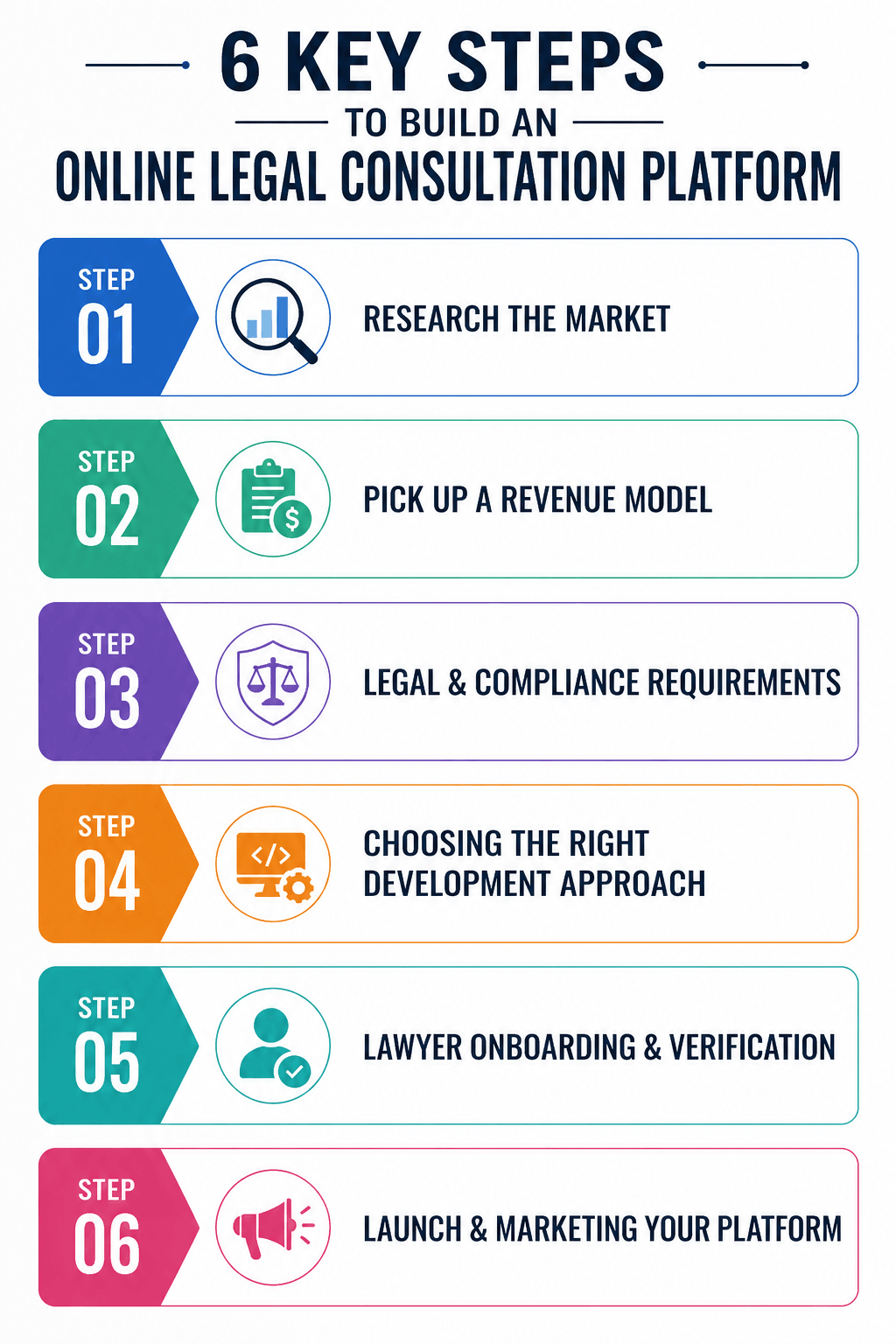
Here are the detailed steps to build an online legal consultation platform:
Step 1: Research the Market
The first step to establish a successful legal consultation platform is positioning it right in the market. For this, study the top competitors in the industry and tap into the relevant market trends. Analyze their features, service offerings, pricing, and marketing strategies.
Keep a track of the online legal industry, prevalent trends, market gaps. High consultation fees, weak mobile optimization, slower responses are some of key user challenges.
Here’s a key questions to perform competitor analysis:
- What is the market size, growth trends and opportunities?
- What are the top competitors in the legal consultation industry?
- What are the key customer segments competitors are targeting?
- What are the platform gaps mentioned in customer reviews?
Step 2: Pick up a Revenue Model
This is one of the most essential steps deciding your platform’s long-term sustainability. Balancing profitability with affordable rates fuels business growth and a rightful implementation of your revenue model.
Here are some key monetization strategies to drive business growth:
1. Commissions
Most online legal consultation platforms take a percentage of sales cut on every consultation. For example, 10%-20% commission per session bookings drives a decent revenue to the platform.
2. Subscriptions
Business owners can earn recurring revenue for providing platform access to users or lawyers. For attorney-side subscriptions, the premium services could include marketplace access, leads, and collaboration tools.
3. Pay-per-Session Video Consultations
Clients can book individual consultations with legal experts matching their requirements and make payments. This is a transaction-based service model, where the platform earns commission or service fee.
4. Document Creation & Review Services
Users can request proposals to craft or review agreements, affidavits, or contracts. Thus, lawyers and platforms can earn additional income from the documentation services.
5. Featured Listings
Lawyers can make additional payments for getting featured as top legal consultants on the platform. This is a win-win for both the platform and lawyers! Lawyers get improved visibility and wider reach, while the platform earns additional revenue.
Step 3: Legal & Compliance Requirements
Complying with regulatory & industry standards is non-negotiable for continuity of your legal consultation platform. From lawyer verification to payment compliance, make sure your platform stays compliant to the evolving landscape.
Here are they key arenas your must consider:
1. Lawyer Verification & Compliance
Be sure to verify the lawyer’s credentials and background before onboarding them. Verify whether they own a relevant bar license and align with local rules . Also, display the lawyer’s qualifications, experience, and areas of expertise, when clients search for them on the platform.
2. Payment Compliance
If your platform accepts and stores payment details, ensure your platform is PCI DSS compliant. Encrypt sensitive payment details, implement strong network security measures, access control, firewalls, etc.
3. Data Protection
You need to comply with the data protection laws, if you manage user profiles or collect and store confidential details. Gather consent before collecting any such information. Ensure payment policy covers what kind of data you collect, how long the data is retained, third-party data sharing practices and security measures implemented.
4. Clear Disclosure of Refund and Payments
Craft a clear refund and payment policy covering the consultation fees, refund eligibility and consultation limitations.
Step 4: Choosing the Right Development Approach
Choosing the right development approach impacts everything from platform costs, efficiency and adaptability. Each approach has its unique characteristics, downsides, and requirements.
Now, let’s look at the two main development approaches!
Custom Development (Building From Scratch)
Building your consultation platform from scratch involves working on every feature, workflow, database and UX element. You can hire developers or build with your in-house team. No matter what you choose, you need to take complete ownership of the entire development process from planning to deployment.
Pros:
- Tailored feature set
- Complete control over design and development
- Full customization & scalability
- Reduced vendor dependency
Cons:
- High project costs
- Long development cycles up to 4 to 12 months
- Complex maintenance & support cycles
- Risk of technical failure and project delays
Ready-made Consultation Softwares (White-Label Solutions)
Most entrepreneurs skip the traditional development approach and choose pre-built frameworks to validate and gather early feedback. Built on proven business models, they are pre-tested, ready-to-deploy, and support high-end customizations.
Pros
- Affordable pricing plans starting from $699
- Faster time-to-market within 1-2 weeks
- Highly customizable
- Scalable architecture
- Long-term maintenance & support
- Full source code ownership & branding
Cons
- Basic setup and configuration
- Software upgrades, releases and security updates depend on the provider
Winner: Pre-built consultation software offers expedited launch and deployment with the market-ready foundational features. This is a future-proof and competitive solution to win the market early. Alternatively, custom development is ideal for businesses with existing flows or distinguished feature requirements.
Step 5: Lawyer Onboarding & Verification
Once you set the platform foundation and align with regulatory requirements, it’s time to balance the platform’s demand and supply sides. Lawyers are the cornerstone of the platform, while clients are your key prospects. So, it’s crucial to get enough lawyers onto your platform, so users get the legal services they are looking for.
Key Onboarding Steps:
- Lawyer Profile Creation & Registration
- Verification of Credentials and Bar Council or License
- Collecting Details on Area of Expertise and Experience
- Signing Confidential Platform Agreements & Contracts
- Monitoring Client Reviews & License Revalidation
Step 6: Launch & Marketing Your Platform
Once you have your business plan, site’s features and development approach, it’s time to launch your legal consultation platform!
Before your website goes live, test all the platform flows, build your brand presence and also gather early feedback. Launch a beta version of your platform with an initial set of lawyers and a group of 5-10 potential users.
Next, it’s time to promote your website across popular marketing channels and capture the interest of your audience.
Effective marketing tactics include:
- Social media
- Landing Page
- YouTube video
- Influencer marketing
- Content marketing
- Paid Ads
Essential Features for Online Legal Consultation Platform
Successful lawyer consultation platforms build a feature-rich interface, combining the right number of essential and unique features. Don’t overwhelm the users with many features or avoid missing out on the important ones.
So, we curated a complete feature list just for you. Here, the essential features are divided into three main user categories: clients, lawyers and admin.
User Features
- Login & Registration
- Lawyer Search & Discovery
- Session Booking & Scheduling
- Live Video Consultation
- Emails & Live Chat
- Ratings & Reviews
- Document Uploading & Sharing
- Secure Payments
Lawyer Features
- Registration & Approval
- Client Management
- Consultation Management
- Rescheduling & Cancellation
- Request Payouts
Admin Features
- User Management
- Lawyer Approval & Registration
- Bookings Management
- Reportings & Analytics
- Platform Settings
- Branding Control
What is the Cost of Building an Online Legal Consultation Platform?
The cost of developing an online legal consultation platform ranges from $40,000 to $70,000. Tailoring your platform to niche audiences and business needs further adds to the platform cost.
White-label consultation software is a cost-effective alternative for modern entrepreneurs to launch within 1-2 weeks, rather than months.
| Platform Complexity | Estimated Cost |
| Basic Platform (User profiles, video calls, session booking payments ) | $40,000 – $70,000 |
| Medium Complexity ( Secure messaging, on-demand legal services, lawyer verification & approval, admin panel) | $70,000 – $1,00,000 |
| Advanced Consultation Marketplace (Advanced AI features, third-party integrations, enterprise-scale applications) | $1,00,000 – $2,00,000+ |
Some of the factors impacting the development costs include:
- Feature complexity
- UI/UX design
- Customizations & integrations
- Tech stack
- Development approach
- Security & compliance
- Development rates & team location
Here’s How Pinlearn can Help:
Pinlearn is an all-in-one consultation software for entrepreneurs to launch an empowering platform that connects legal consultants with clients. From real-time video meetings to appointment scheduling and streamlined payments, it’s the ultimate consultation software. It offers a powerful feature set for clients to seek the best legal advice, for coaches to seamlessly manage their business and for admins to streamline their day-to-day business operations.
Benefits of Using Pinlearn as Online Legal Consultation Platform:
- Client & Consultant Management Interface
- Integrated Calendar & Booking Management
- Live One-to-One and Group Sessions & Interactive Tools
- Robust Content Management System (CMS)
- Comprehensive Tracking & Analytics
- Multiple Revenue Streams such as commissions, subscriptions, and ads
- Easy Setup & Customizable Workflows
Conclusion
Launching your online legal consultation business is certainly a resounding business idea! We understand how overwhelming it could be for new entrepreneurs and startups to get past the early development stages. Hence, we have written this comprehensive guide with detailed steps, revenue strategies, practical tips and smart development alternatives to support your long-term goals.
You can trust this blog as a go-to-resource from setting to scaling your consultation business! Connect with our team of engineers, to launch a successful online legal consultation platform today!
FAQ-Related to How to Build an Online Legal Consultation Platform
1. What types of legal services can be provided through digital legal consultation platforms?
Drafting or reviewing business documents, privacy policy, vendor contract, lease agreement, wills, estate planning, copyrights and trademark. Additionally, video consultations help clients to seek legal advice from legal consultants.
2. Can lawyers provide legal advice online?
Yes, lawyers can offer legal advice through online consultations, email or legal platforms or marketplaces. Users can seek specific legal advice or complete specific documentation work as per needs.
3. What are the monetization strategies for legal consultation platforms?
Commissions, monthly subscriptions, live video consultations, featured listings and platform fees are top monetization strategies for online legal consultation platforms.
4. Do legal consultation platforms need lawyer verification?
Yes, platforms need to verify lawyer credentials and perform background checks while onboarding. This ensures legitimate legal advice, mitigates platform liability and ensures compliance.
5. How much does it cost to build a legal consultation platform?
The cost of developing a legal consultation platform ranges from $40,000 to $2,00,000+ approximately, depending on project complexity, tech stack, UX design, and development approach.
6. Can you build an online legal consultation platform without coding?
Yes, pre-built legal consultation platforms help entrepreneurs and startups to build an online legal consultation platform without any coding skills.
7. How long does it take to build a digital legal consultation platform?
Custom development takes 4 to 12+ months to build a full-fledged consultation platform. Using white-label coaching software, cuts down the project costs and speeds up the launch to 1-2 weeks, rather than months.