

Why Choose a White-Label LMS for Building an E-Learning Platform?

TL;DR
- A white-label LMS helps businesses launch a branded e-learning platform without building an LMS from scratch.
- Compared to custom development, it offers a faster time to market, lower initial investment, easier customization, and reduced development complexity.
- Businesses can customize branding, manage courses and learners, integrate payments, and scale their platform as their user base grows.
- While a custom LMS provides greater flexibility and control, it typically requires a higher budget, longer development timeline, and ongoing technical maintenance.
- Choosing the right white-label LMS depends on factors such as features, scalability, customization options, hosting model, and long-term business goals.
- Solutions like Pinlearn provide a ready-made, self-hosted white-label LMS that supports self-paced courses, live tutoring, source code access, and multiple monetization options
An e-learning business needs more than a collection of online courses. It also requires a platform to manage learners, instructors, courses, assessments, payments, and day-to-day operations.
Building an LMS from scratch can take months and require considerable development resources. A white-label LMS offers an alternative by providing a pre-built platform that businesses can adapt to their brand and learning requirements.
In this guide, we’ll explore what a white-label LMS is, how it compares with custom LMS development, why businesses choose it for e-learning platforms , the key features to consider, and the potential costs involved.
What is a White-Label LMS?
A white-label LMS is a ready-made learning management platform that businesses can brand and launch as their own. It comes with essential tools for managing courses, learners, instructors, and assessments, reducing the need to develop an LMS from scratch.
Depending on the provider, businesses can customize the platform to support different learning models, branding requirements, and workflows, making it easier to align the LMS with their business goals.
White-Label LMS vs. Custom LMS For Your E-Learning Platform
A white-label LMS provides a ready-to-launch foundation that helps businesses enter the e-learning market quickly and efficiently. It comes with pre-built features such as course management, learner administration, assessments, analytics, and reporting.
This makes it a practical choice for startups, training providers, and organizations that want to launch a branded learning platform while reducing development time and technical effort.
A custom LMS, on the other hand, is developed around a business’s specific requirements. It allows organizations to build specialized workflows, advanced integrations, and tailored features that may not be available in standard LMS solutions.
This approach can be more suitable for enterprises or businesses with complex learning models that require greater control over platform functionality.
The primary difference between the two lies in flexibility, cost, and technical ownership. While a white-label LMS enables faster deployment with lower technical overhead, custom LMS development typically involves a higher upfront investment, longer implementation timelines, and dedicated resources for maintenance, upgrades, and future enhancements.
Why Choose a White-Label LMS for Building an E-Learning Platform?
Every business has different priorities when building an e-learning platform. Some want to launch quickly, others focus on reducing development costs while many look for a balance between customization, scalability, and operational requirements. A white-label LMS addresses many of these requirements by providing a ready-made foundation that businesses can customize and scale over time.
However, the value of a white-label solution depends on the platform you choose. Features, customization options, scalability, hosting, and integrations can vary between providers.
Here are some of the key reasons businesses consider a white-label LMS for building an e-learning platform:
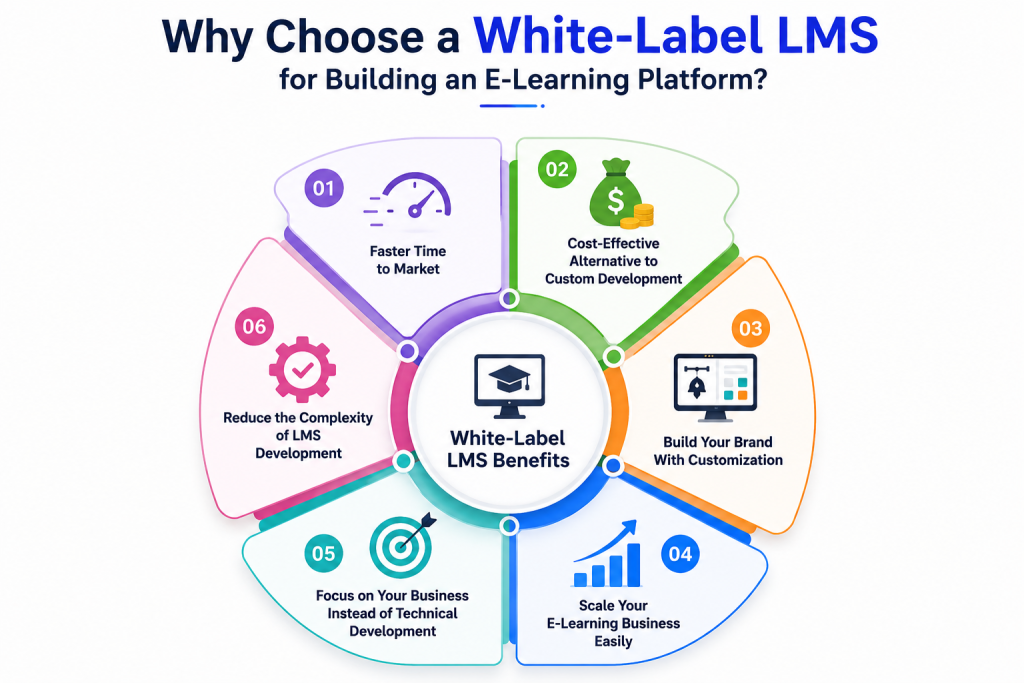
1. Faster Time to Market
Developing an LMS from scratch involves planning, designing, developing, testing, and deploying the platform. Depending on the scope and complexity of the project, this process can take several months before the platform is ready for users.
A white-label LMS provides a ready-made foundation with essential features already in place. Businesses can customize the platform, add their branding, upload courses, and configure the required payment options without building the core LMS functionality from the beginning.
This allows businesses to get their platform ready faster and start serving learners sooner. It also gives them the opportunity to gather user feedback and make improvements based on actual learner needs.
2. Cost-Effective Alternative to Custom Development
Building an LMS from scratch requires investment in developers, designers, testing, security, integrations, and ongoing maintenance. Depending on the platform’s complexity, custom LMS development can cost anywhere from $20,000 to $250,000 or more.
A white-label LMS can reduce the initial investment by providing core LMS functionality that is already developed. For example, Pinlearn’s LMS clone script offers a one-time payment model, with $1,500, depending on the selected package and included features.
This allows businesses to avoid spending their entire budget on developing standard LMS functionality and instead allocate resources to areas such as course creation, marketing, instructor acquisition, and learner engagement.
While additional expenses for customization, hosting, integrations, and maintenance should be considered, the overall investment is often lower than developing an LMS entirely from scratch.
3. Branding & Customization Capabilities
A white-label LMS allows organizations to deliver courses and training under their own brand, creating a consistent learning experience across every learner touchpoint.
Rather than directing users to a third-party platform, organizations can customize the LMS to align with their branding, business model, and learner expectations. Most white-label LMS platforms allow businesses to customize elements such as:
- Logo and brand colors
- Custom domain
- Course pages
- Learner dashboards
- Email notifications
- Certificates
- Other learner-facing components
These capabilities are particularly valuable for corporate training providers, coaching businesses, professional certification programs, and subscription-based learning platforms that require a cohesive and branded user experience.
When evaluating a white-label LMS, it is important to assess the level of customization offered by the provider. Some platforms provide basic branding options, while others support advanced capabilities such as white-labeled mobile applications, multi-tenant learning portals, custom user roles, and API integrations.
4. Scale Your E-Learning Business Easily
Your platform requirements can change significantly as your learner base and course catalog expand. As your business grows, your LMS should be able to support:
- Growing numbers of learners
- Larger course libraries
- Additional instructors and tutors
- Increasing platform activity and user traffic
- Multiple payment methods and currencies
- Expansion into new markets
Some white-label LMS providers also offer self-hosted deployment options, giving organizations greater control over hosting environments, data management, and technical configurations. This can be particularly useful for businesses with specific compliance, performance, or infrastructure requirements.
Before selecting a white-label LMS, evaluate how well it supports increasing users, content, traffic, and operational requirements. Choosing a scalable platform reduces the need for major system changes as your business expands.
5. Focus on Learning and Business Operations
Running an e-learning business involves much more than managing technology. Organizations must continuously invest in course development, learner support, instructor management, marketing initiatives, and overall platform growth.
Building and maintaining an LMS internally can require dedicated technical resources to manage updates, integrations, security requirements, and system maintenance.
These responsibilities can divert time and resources from activities that directly contribute to business growth and learner success.
By adopting a white-label LMS, organizations can allocate greater attention to areas such as:
- Creating and improving course content
- Supporting learners and instructors
- Marketing and learner acquisition
- Expanding the course catalog
- Building a learning community
- Exploring new revenue opportunities
While certain technical responsibilities may still exist depending on the deployment model, a white-label LMS enables organizations to prioritize their learning and business objectives rather than managing the core LMS framework.
6. Reduce the Complexity of LMS Development
An LMS consists of several interconnected components beyond course delivery. Features such as user authentication, role-based permissions, payment processing, reporting, security controls, and data management are essential to ensuring the platform operates reliably and securely.
Developing and maintaining these capabilities requires technical expertise, thorough testing, and ongoing system management. Without adequate planning and resources, organizations may encounter implementation challenges, security vulnerabilities, and increased maintenance requirements.
A white-label LMS addresses many of these technical considerations by providing pre-built and tested LMS functionalities that can be configured based on business requirements. This allows organizations to concentrate their technical efforts on customization, integrations, and learner experience rather than developing foundational LMS components.
For businesses looking to launch an e-learning platform, adopting a white-label LMS can significantly simplify the technical aspects of implementation and ongoing platform management.
7. Pre-Integrated Monetization
A white-label LMS can also simplify the process of setting up revenue streams by providing pre-integrated monetization options. Depending on the platform, businesses may be able to sell courses, offer subscriptions, provide paid tutoring sessions, or support other learning-based services without developing these payment and monetization workflows from scratch.
This allows businesses to configure their preferred revenue model and focus on growing their course offerings and learner base while reducing the technical complexity involved in implementing monetization features.
For businesses looking to launch an e-learning platform, adopting a white-label LMS can significantly simplify the technical aspects of implementation and ongoing platform management.
Key Features to Look for in a White-Label LMS
Branding is only one aspect of choosing a white-label LMS. Businesses should also evaluate whether the platform includes the features required to deliver an effective learning experience and support future growth.
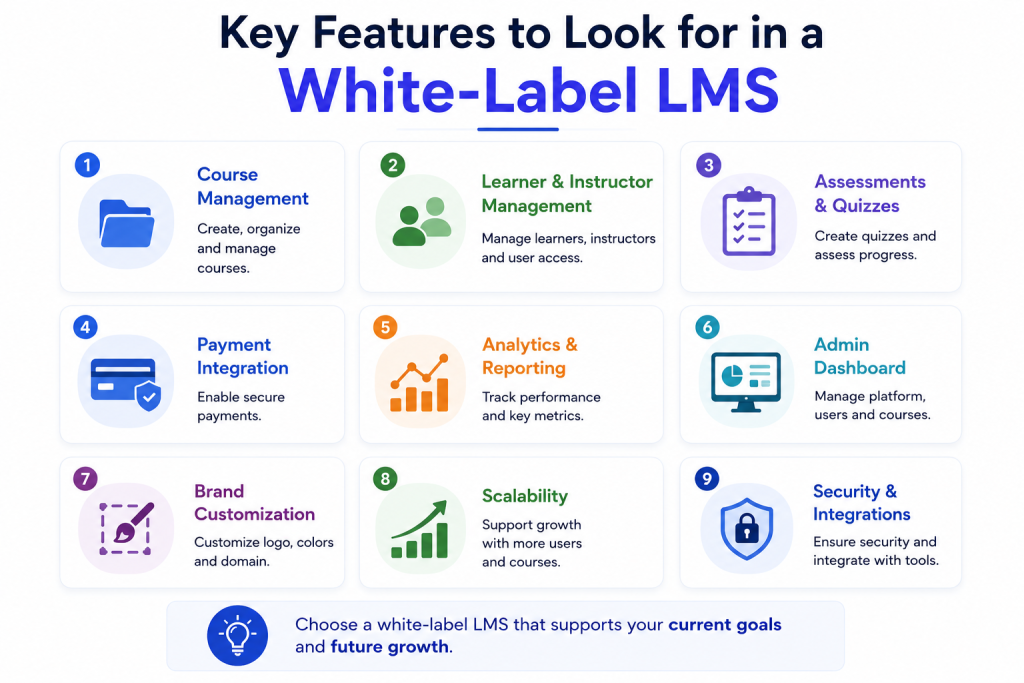
Here are some key features to look for:
- Course Management: Tools for creating, organizing, updating, and delivering courses and learning materials efficiently.
- Learner and Instructor Management: Allow businesses to manage learners, instructors, roles, and user access from a centralized platform.
- Assessments and Quizzes: Support quizzes, tests, and assessments to help measure learner progress and knowledge.
- Payment Integration: Enable secure payments for paid courses, subscriptions, and other learning services.
- Analytics and Reporting: Provide insights into learner activity, course performance, enrollments, and other important metrics.
- Admin Dashboard: Offer a centralized dashboard to manage the platform, users, courses, and other operations.
- Brand Customization: Allow businesses to customize branding elements such as logos, colors, domain names, and platform design.
- Scalability: The ability to accommodate increasing numbers of users, courses, and platform activity as the business grows.
- Security and Integrations: Support robust security measures and seamless integration with essential third-party services, including payment gateways, CRM systems, video conferencing tools, marketing platforms, and other business applications.
Before selecting a platform, it is important to evaluate the essential features of an e-learning platform and compare them with your business requirements. This helps you choose a white-label LMS that supports both your current needs and future growth.
Why Choose Pinlearn for Your White-Label E-Learning Platform?
The right white-label LMS should offer more than basic branding options. Businesses should also consider the level of control they have over the platform, the learning models it supports, and the flexibility available for future customization.
Pinlearn’s White-Label LMS offers a ready-made solution that businesses can use to launch a branded e-learning platform with features designed for both self-paced learning and live tutoring.
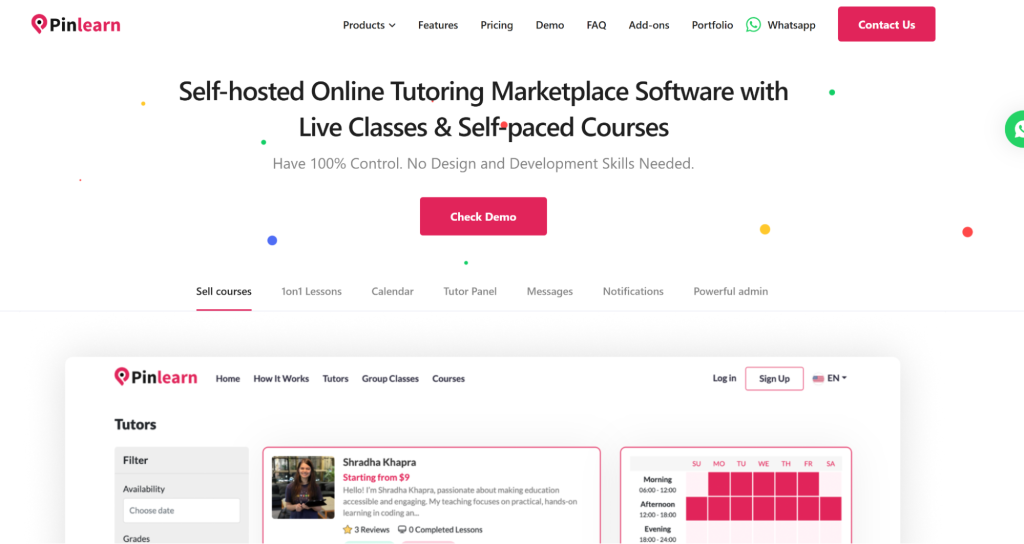
Here are some factors that may make Pinlearn suitable for businesses exploring a white-label LMS:
- Hybrid Learning: Supports self-paced courses alongside live tutoring, one-on-one sessions, and group learning experiences.
- Source Code Access: Provides access to the source code, allowing businesses to implement customizations and extend platform functionality based on specific requirements.
- White-Label Platform: Businesses can adapt the platform’s branding to create a learning environment under their own identity.
- Multiple Monetization Options: Supports various revenue models, including course sales, tutoring services, subscriptions, and other learning-based offerings.
- Self-Hosted Solution: Gives businesses greater control over their hosting environment platform configurations, and data management.
- One-Time License: Offers a one-time licensing model, helping businesses avoid recurring licensing fees associated with some SaaS-based LMS platforms.
These capabilities make Pinlearn a potential option for startups, training providers, tutoring businesses, and entrepreneurs who want to launch a branded e-learning platform while maintaining greater control over their technology.
Conclusion
The right LMS approach depends on your budget, timeline, business requirements, and long-term goals. Custom development offers greater control over the platform but generally requires more time, investment, and technical resources. For many startups, educators, training providers, and businesses, a white-label LMS offers a faster and more cost-effective path to launching an online learning platform. By choosing a solution that aligns with your goals, you can focus on growing your business while reducing the complexity of LMS development.
FAQs About White-Label LMS for Building an E-Learning Platform
1. Why should businesses choose a white-label LMS?
Businesses can choose a white-label LMS to launch an e-learning platform faster, reduce development complexity, and build a branded learning environment without developing the entire platform from scratch.
2. What are the main benefits of a white-label LMS?
The main benefits include faster time to market, lower initial development costs, brand customization, scalability, reduced technical complexity, and less time spent managing core LMS development.
3. Is a white-label LMS better than a custom-built LMS?
It depends on your business requirements. A white-label LMS suits businesses seeking a faster, more cost-effective launch, while custom development may be better for organizations needing highly specific functionality and complete control.