
How to Build an Online Tutoring Platform Like Cambly?
The introduction of English language learning platforms has transformed how we learn English across the globe. The paradigm shift from blackboards to AI-based conversation practices is immense and shows the industry is evolving rapidly.
Cambly is one of the leading platforms with $250 million in revenue, innovating the language learning space. While it continues to evolve with technology and learner needs, the demand for English learning is set to grow further.
If you’re an aspiring entrepreneur, here’s a complete blueprint on “how to build an online tutoring platform like Cambly.” From how it works to the step-by-step plan and the best development approach, you’ll find everything you need in this guide!
Key Takeaways:
- Cambly is an English learning platform connecting learners with native English speakers through one-to-one and small group lessons.
- Students can connect instantly with native English tutors or pre-schedule lessons.
- Cambly works on a subscription-based model. It makes revenue from student learning plans, B2B partnerships, Cambly Kids, and upsells.
- To build a Cambly-like platform scale on a real-world problem and understand your audience well.
- Choose the right business model and generate additional revenue from partnerships, advertising, and in-app purchases.
- It takes $50,000 to $70,000 approx to build a Cambly-like website from scratch.
- Ready-made clone scripts like Pinlearn reduce the long-term cost and help to launch your platform within weeks.
What is Cambly and How Does it work?
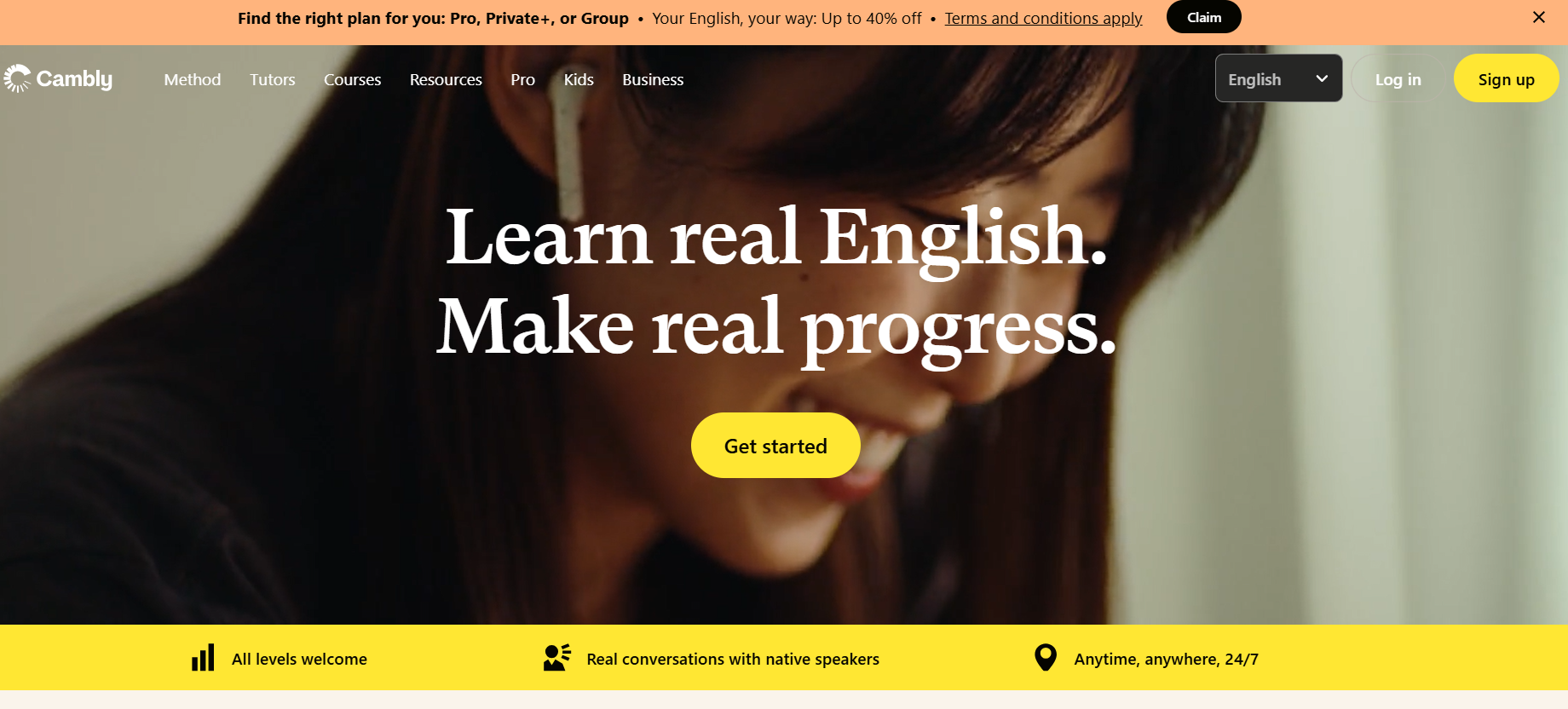
Cambly is an English-learning platform that connects learners with native English speakers. The platform offers one-to-one tutoring and small group lessons based on your subscription plan. Instant access to native English-speaking tutors without prior scheduling is one of the significant benefits of Cambly.
Students get conversational practice through live classes and pre-recorded courses. Cambly offers 24/7 access to English tutors from the US, Canada, UK, Ireland, Australia, South Africa, and New Zealand. There’s no fixed curriculum on Cambly, and students opt for 15-minute, 30-minute, or 60-minute lessons.
How Does Cambly Work?
Here’s how Cambly works for students and tutors:
Students:
- Learners sign up and set up their accounts.
- Personalize learning by choosing the level of proficiency ( beginner, intermediate or advanced) and learning goals.
- Choose a subscription plan (Small groups, Private, or Pro) and the number of lessons per week. Cambly calculates how much the learner pays monthly.
- Find the right tutor based on preferences or explore the course library.
- Instantly connect with tutors or book a specific slot in advance.
- Lessons happen through live chat, and learners practice their speaking and listening skills.
Tutors:
- Tutors sign up and create an account on Cambly.
- Fill out the forms – basic details, experience, and intro video. Cambly reviews and informs about the selection.
- Set your availability or block slots for specific students.
- Offer personalized lessons through live chat based on student goals.
- Cambly pays tutors on a per-minute basis ($0.17/min for Cambly and $0.20/min ($12/hour) for Cambly Kids.
- Tutors can withdraw their earnings weekly through PayPal, direct deposit, etc.
Benefits of Creating a Tutoring Platform Like Cambly
Let’s explore the advantages of building a Camby-like platform!
1. Revenue & Profitability
The language learning space holds strong revenue potential thanks to globalization, travel industry growth, technology and AI advancements. Cambly hit the $250 million revenue mark in 2024 after its launch in 2012.
2. Accessibility & Flexibility
Students can take live classes anytime through the internet, and tutors can share their knowledge at their convenience.
3. Diversified Revenue Streams
Language tutoring platforms monetize from tutor commissions, subscription plans, corporate partnerships, pay-per-minute sessions, and specialized language services.
4. Personalized Learning
Cambly doesn’t adopt a one-size-fits-all approach; it creates tailored vocabulary and grammar activities and AI-driven feedback.
5. Global Reach
Cambly connects students with language experts across the globe based on student preferences.
How to Build an Online Tutoring Platform Like Cambly: Step-by-Step Guide
Cambly started with a vision of accessible English education for everyone. It scaled on a massive problem with a potential $1.5 billion curious English learners. From an MVP with a single “Practice English” button, the product has quickly scaled to millions of users. Cambly hit the right notes with a profitable business idea, targeting emerging markets, and an on-demand learning model.
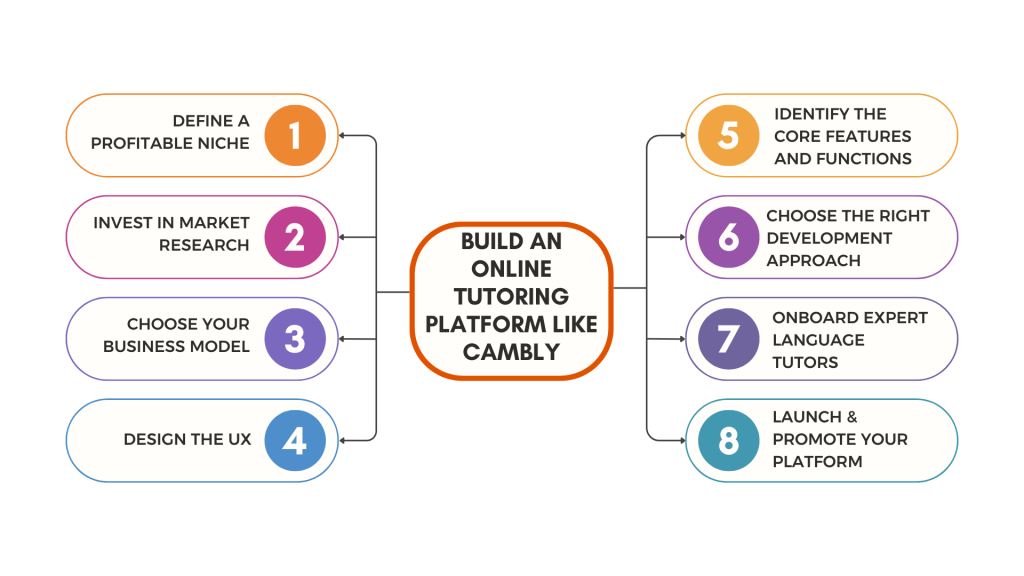
If Cambly’s growth story inspires you, here’s a detailed guide on how to build an online tutoring platform like Cambly:
Step # 1: Define a Profitable Niche
Now, you’re inspired by one of the best English learning platforms and have a few workarounds to do it. But there’s an unsettling question – why would learners choose my platform?
Yes, the language learning industry is growing significantly with new players joining the space! Defining a scalable vision essentially depends on choosing a profitable niche.
Here are some effective strategies to find your ideal niche:
- Evaluate Your Expertise and Education: Are you passionate about languages or an expert? You can turn your passion into a business and share your knowledge and offer accessible language offerings.
- Identify Your Target Audience: Niche down your business to a specific purpose, group, or demographics. For example, language learning for kids or English for travellers.
- Analyze Competitors: Research the 2-3 top competitors in your niche. For example, Preply and Italki are key competitors for Cambly. Evaluate the audience segments they serve, language services, pricing, and scalability.
- Assess Market Demand and Trends: AI-powered learning, bite-sized lessons, and social learning are key trends in the industry.
💡Tip: Use tools like Google Trends, Ahrefs, subreddits, and other language learning communities to get into discussions and keep an eye on trends.
Business English for corporate professionals, conversational English for adults, exam preparation, and industry-specific English are popular niches for starting a Cambly-like platform.
Step # 2: Invest in Market Research
The road to your platform’s glory lies in the right groundwork! Understanding your customers’ needs and interests leads to an innovative platform that resonates with your audience.
Besides, a great grasp of your target audience helps to adopt resounding marketing strategies. Before starting with market research, you need to know who your target audience is. And choose one or two audience segments.
Key strategies for market research:
- Know your audience – Use focus groups, surveys, feedback forms, and polls to identify their needs, expectations, and pain points.
- Validate market – Perform A/B testing with emails, landing page, and trial lessons.
- Create buyer personas – Build key buyer personas to tailor your platform to user needs.
- Evaluate profitability – Gauge how much learners are willing to pay and set your price point.
- Assess the Tutor Availability – Research tutor availability, hourly prices, and strategies to attract them.
Step # 3:Choose Your Business Model
An executable and realistic framework transforms your business idea into a profitable venture that succeeds in the long run.
Let’s take a closer look at Cambly’s business model! The platform runs on a subscription model where learners can take up different plans based on their needs. Cambly makes money through subscription plans, Cambly Kids, corporate training, and premium upsells.
We know a one-size-fits-all approach doesn’t always work. So, look beyond ROI and prioritize user experience.
Popular business models in the language learning industry are:
- Pay-per-lesson or pay-per-minute – Charge students for individual sessions or based on total duration.
- Packages & Bundles – Sell packages or bundles of hours or lessons at discounted rates.
- Freemium Model – Provide basic features for free; charge for premium upgrades like 1:1 live tutoring, learning resources, etc.
- Ad-Based Model – Monetize by selling ad spaces to educational brands.
- In-App Purchases – Earn revenue from personalized lessons, test preparation materials, and practice exercises.
- Partnerships & Sponsorships – Collaborate with educational institutions and brands for corporate training and curriculum-based learning.
Step # 4: Design the UX
Design is a crucial component of language learning platforms. Your main goal should be to design an easy and user-friendly interface connecting tutors with students.
Key Design Principles for Designing a Cambly-like Platform:
- Plan User Flow – Ensure an intuitive and frictionless user journey from onboarding to live tutoring.
- Personalize Onboarding – Tailor learning experience based on goals and proficiency.
- Navigation & Clean Layout – Clear menus and layouts offer effortless navigation, enhancing the platform experience.
- Visual Design – Include visual cues, progress bars, feedback, gamification, and micro UX elements in the lesson interface.
- Interactive & Responsive Design – Embed AI conversational practice and instant feedback.
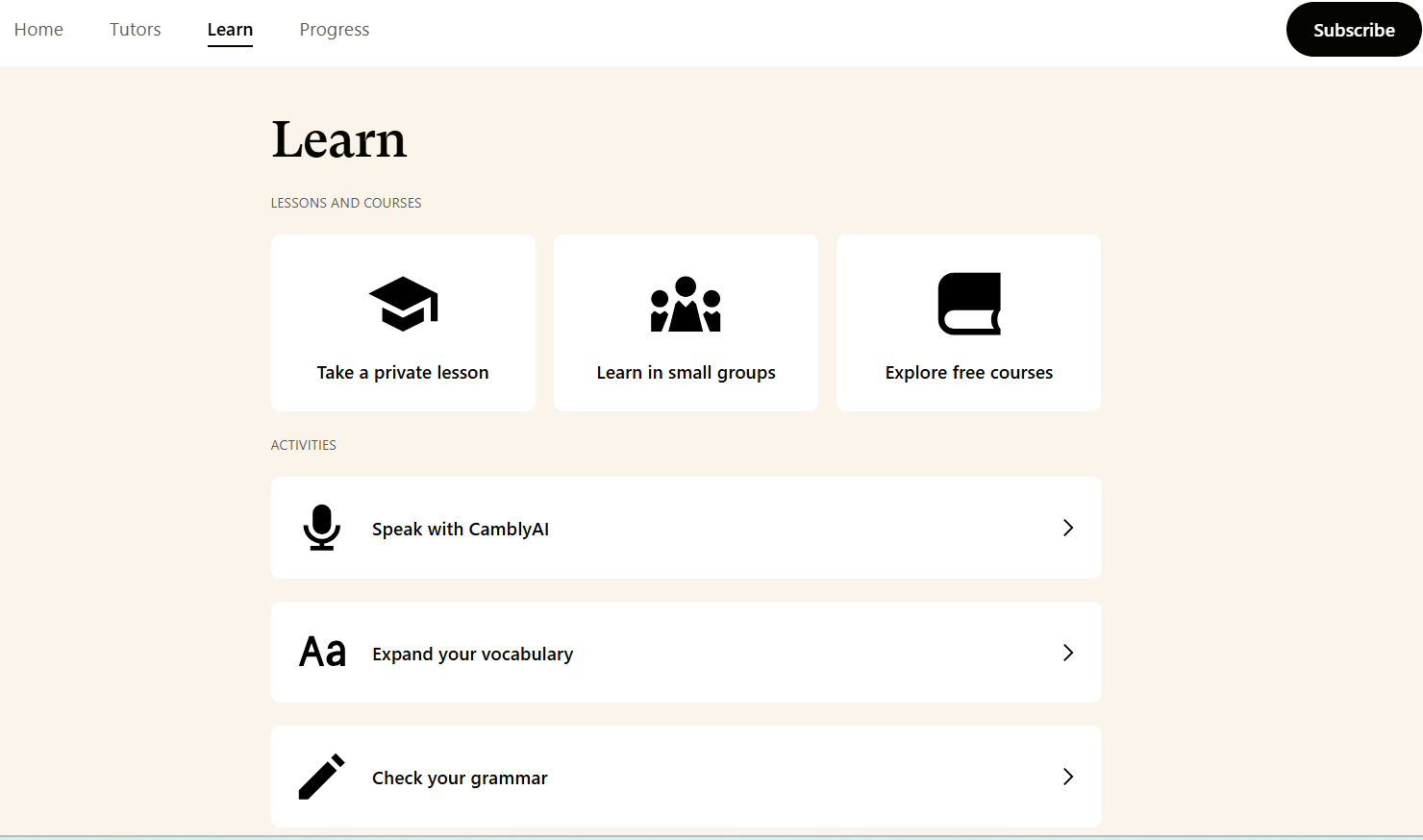
💡Looking for some design inspiration? Our guide on top UX best practices for modern e-learning platforms helps to fill your blank canvas.
Step # 5: Identify the Core Features and Functions
Determining the core features and functionalities helps to get the foundation right. These features work towards solving your problem.
Identify the key users and their goals to settle on the right features. The small scope makes the cut!
Let’s look at the key features for users, tutors, and admin!
Key Features for Users
- Easy login & onboarding
- One-on-one or group sessions
- Video Conferencing integration & online whiteboards
- Translation-enabled chat & screen sharing
- Personalized vocabulary, quizzes, activities,
- AI Feedback
- Progress Tracking
- Payment Integration
- Pre-recorded Courses
- Browse & filter tutor profiles
- Scheduling tutoring sessions in advance
- Subscription Plans with different feature access
Key Features for Tutors
- Profile Creation & Verification
- Track & manage appointments with calendar sync
- Time Zone Settings
- Virtual classroom for individual and group tutoring
- Lesson Feedback Notes
- Dashboard & Tutor Analytics
- Initiate Payouts
- Tutor Ratings & Reviews
Key Features for Admin
- Student Management
- Tutor Management & Approval
- Session tracking & Management
- Admin dashboard for tracking payments, revenue, and payouts
- Notification & Communication
- Platform & Security Settings
- Branding & Customization
- Coupons & Discounts
💡Need a complete guide on the essential features for your tutoring platform? Here’s the ultimate feature checklist to make your development process easier.
Step # 6: Choose the Right Development Approach
There are two ways to build your Cambly-like website: Camly clone scripts and custom development. Your development approach influences your development time, cost, scalability, customization, and overall platform success.
Using a Ready-made Cambly Clone Script
Cambly clone is a pre-build software, offer all the core features and functionalities of the Cambly platform. This reduces the overall development cost and time-to-market. Whether you need live tutoring, intelligent tutor-student matching, or payment integration, you’ll find it all in one place.
Pros
- Quick launch within weeks
- Cost-effective
- Highly-customizable
- White-labeling and unique branding
- Complete control over design and development
- No coding skills required
Cons
- Needs basic setup for customization
Custom-Development (Building from scratch)
Building from scratch is a time and resource-intensive process. You need a dedicated tech team to build the platform from requirement gathering to testing and final launch. This takes over 6 months to even a year, with a significant development cost.
Pros
- Customizable to business needs
- High scalability
- Full control over design and development
Cons
- Long development cycles (6 months to one year)
- Higher development cost
- Dedicated tech team and resources
- Potential risks and delays
Clone Script Vs. Custom Development: Which One is the Best Approach?
|
Development Approach |
Launch Time | Long-term Cost | Coding Skills | Scalability | Customization |
|
Clone Script |
Quick launch within weeks | Low Cost | No coding skills | High | Highly customizable & 100% open source code |
|
Custom Development |
6 months – 1 year | High cost | Coding skills or dedicated tech team | High | High-customization |
Overall, clone scripts are ideal if you value speed and a proven industry model. Most businesses prefer a proven Cambly clone script, given its power-packed features, quick launch, and affordable pricing. The 100% open source code allows custom workflows and unique branding tailored to business needs.
Step # 7: Onboard Expert Language Tutors
While you might have scaled a million-dollar idea and deployed the best-in-class tech stack, the quality of tutors decides your platform’s success. Hence, design a fair and streamlined selection process for screening the right candidates.
For example, Cambly hires native and near-native English speakers as tutors. This helps the ESL platform deliver quality English lessons to its learners.
Important Tutor Onboarding & Recruitment Strategies:
- Define minimum eligibility criteria for tutors (e.g., above 18 years, bachelor’s degree, teaching certification)
- Tutor registration and profile completion with bio details and demo videos
- Next, the candidate needs to complete language assessments, verification and interviews before selection.
- On selection, tutors can customize their profile, set availability, and decide on competitive rates.
- Offer seamless onboarding with walkthroughs, guides and workshops.
Step # 8: Launch & Promote Your Platform
Finally, it’s about time for the big launch when your website goes live!
You can make a soft launch initially for a selected group of learners. Gather feedback on the feature, UX, and overall experience. Improve your platform and fix the bugs and technical issues.
Next, attract students and scale your tutoring business. And that’s where a solid marketing strategy helps!
Effective Marketing Strategies:
- Social Media Marketing – Share short videos, challenges, and testimonials on X, Instagram, and TikTok.
- Offer Trials and Discounts – Provide free demo lessons and discounted bundles to attract learners.
- Paid Advertising – Target relevant keywords on Google search ads and social media ads.
- Email Marketing Campaigns – Send weekly emails, welcome sequences, and promotional offers to audiences.
- Institutional Partnerships – Reach out to schools, educational institutions, and corporate businesses to expand reach.
- Blog & Educational Resources – Curate an extensive library of how-to-blogs, valuable tips, and recent trends.
- SEO – Optimize your website for on-page SEO and target top keywords like “learn English online”, “English tutors online”, etc.
Conclusion
Cambly’s success story is a result of a well-executed business model, instant access to native English tutors, and precise positioning. Diversifying revenue with subscription plans, corporate partnerships, specialized offerings, and upsells, the platform has made significant revenue.
The key takeaway here is how Cambly scaled the high-potential English learning market and built a convenient way to connect students with tutors.
This blog offers a detailed roadmap on how to build an online tutoring platform like Cambly. So, identify a real-market problem and let your platform be an effective solution bridging the industry gap! Let’s build the next Cambly of the industry with Pinlearn today!
⚡Related:
FAQ-Related to How to Build an Online Tutoring Platform Like Cambly
1. How much does it cost to build an online tutoring platform like Cambly?
The cost to develop an online tutoring platform like Cambly is $50,000 to $70,000 approximately when building from scratch. The actual cost depends on your feature complexity, location, customization, and hourly development rates. Using readymade clone scripts like Pinlearn is cost-effective and comes at a one-time cost with no recurring charges.
2. How does Cambly work?
Cambly primarily operates on a subscription-based model. It allows platform learners to connect with native English speakers through live chat without prior booking.
3. Who can use a tutoring platform like Cambly?
Students who want to improve their English fluency and native English speakers offering tutoring services use Cambly.
4. What is the tech stack needed for a Cambly-like website?
The recommended tech-stack for building a platform like Cambly includes:
- Front-end: React, Angular, Vue.js
- Back-end: Django/Python, Node.js, Ruby on Rails
- Database: MongoDB, MySQL
- Integrations: Real-time Video Integration with Zoom, LessonSpace, and Twilio, Payment integration with Stripe and PayPal
5. How can I integrate AI features in a tutoring platform?
Integrate AI in your tutoring platform for personalized lesson plans, instant feedback, tailored quizzes and activities, and 24/7 chatbots.
6. How does Cambly make money?
Cambly generates revenue from subscription plans, pay-per-minute sessions, corporate partnerships, and specialized offerings like Cambly Kids.
7. How long does it take to build a tutoring platform like Cambly?
For a Cambly-like website, building from scratch takes 6 -12 months, and ready-made clone scripts like Pinlearn help to launch within a few days.