Udemy Business Model: How It Makes Money & How You Can Use It?

Key Takeaways:
- Udemy operates on a marketplace model, monetizing from both its course marketplace (B2C) and Udemy Business (B2B).
- Key revenue segments: Course sales commissions, subscriptions, mobile in-app purchases, connect 1-1, and enterprise plans.
- Udemy follows a revenue-sharing model for course sales, where it pays instructors 37%- 97% of course revenue.
- Accessibility, affordable pricing, global presence, and AI-powered capabilities define Udemy’s value proposition.
Udemy is one of the leading edtech giants, leading the $299.67 billion e-learning market. If you’re launching in the e-learning space, the Udemy business model is worth understanding! The platform’s struggles-to-success story provides some key lessons on market adaptation, strategic business shifts, and effective positioning.
In this article, we delve into Udemy’s business model, how Udemy works, core revenue streams, future outlook, and key lessons to start a Udemy-like website. So, let’s get started!
How Does Udemy Work?
Udemy is a popular online learning marketplace offering courses across diverse niches like development, business strategy, finance, digital marketing, personal development, etc. There are two primary segments: Udemy’s B2C marketplace and Udemy Business (B2B).
The platform acts as an intermediary connecting learners with instructors.
For Instructors: They can create and upload different courses, sharing their expertise and skills. They decide the course prices from which the platform takes a 3% – 63% commission and uses it for marketing, sales, and business operations.
For Learners: Students can enroll in a free or paid course and learn at their own pace. Meanwhile, they get access to video lessons, slides, presentations, transcripts, etc. On successful completion of paid courses, Udemy offers a completion certificate.
Udemy’s Success Story & Timeline
Udemy’s remarkable success story shows how to build a billion-dollar business with zeal and a strategic pivot. From its inception, Udemy’s founders knew they didn’t need the perfect business idea, but knew how to tailor their product idea to the evolving market and trends. Innovation and technology are key catalysts driving Udemy’s growth, facilitating a deeper and more inclusive learning experience.
Udemy’s Timeline
After Udemy’s powerful growth story, let’s traverse through its key milestones!
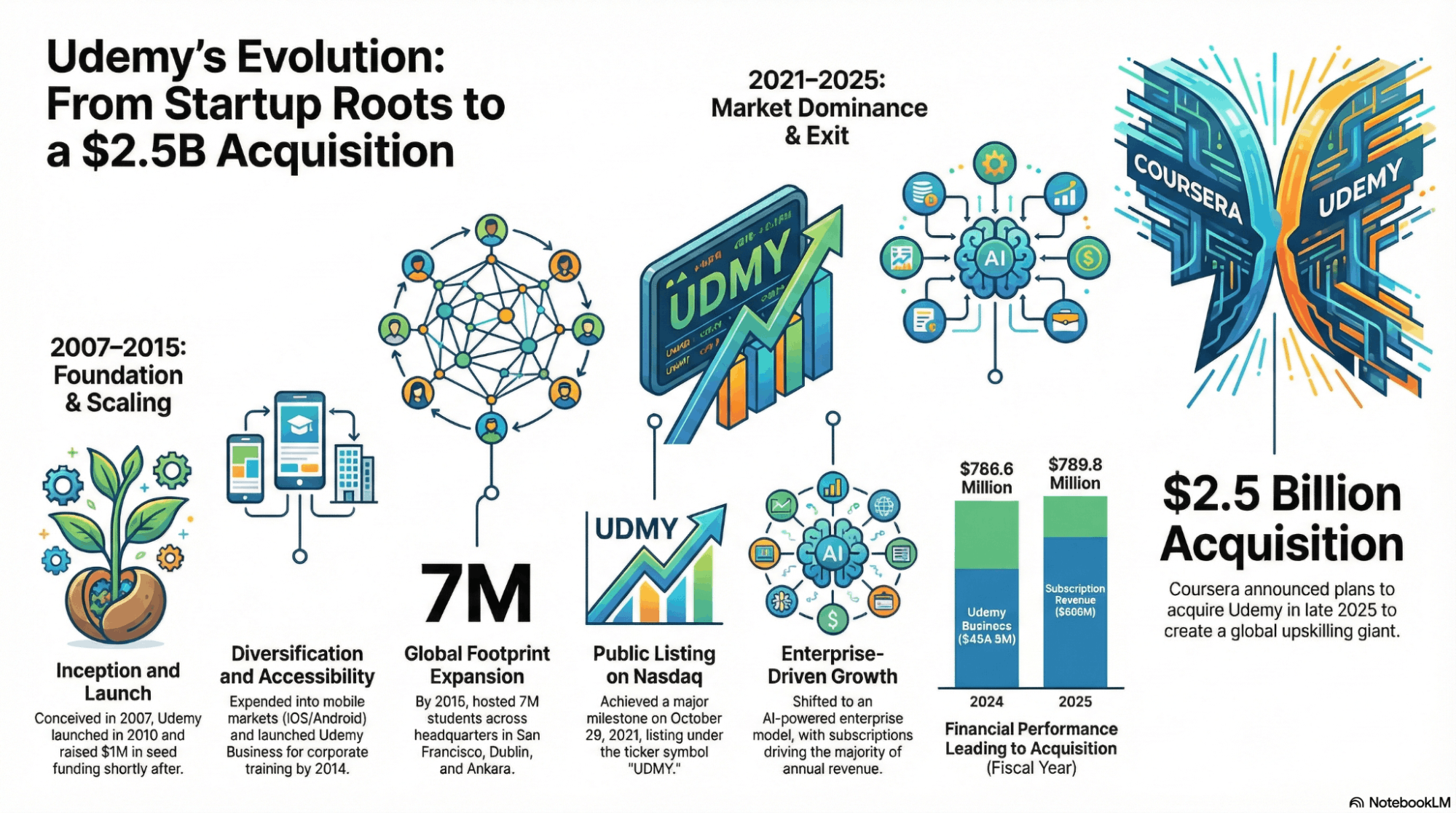
- 2007: Eren Bali came up with the idea of live virtual classroom software in Turkey.
- May 11, 2010: Udemy was launched in San Francisco, California, by founding members Eren Bali, Gagan Biyani, and Oktay Caglar.
- August 2010: The platform raised its first seed round of $1 million.
- April 2013: Entered the mobile app market with iOS app launch.
- 2013: Launched Udemy Business for strategic expansion into the corporate learning market.
- January 2014: Introduced the Android app, in January 2014 increasing mobile accessibility.
- 2015: Udemy has established headquarters in San Francisco, Dublin, and Ankara. Hosts around 7 million students and received $65 million by June 2015.
- October 29, 2021: Udemy officially listed on Nasdaq under ticker ‘UDMY.’
- June 2015: Secures a $65 million Series D funding round led by Stripes.
- November 2024: Rolled in the AI-powered skills mapping feature for enterprise customers.
- Full Year 2024: Reports total revenue of $786.6 million with Udemy Business as the primary driver, contributing $494.5 million.
- Full Year 2025: Reports total revenue of $789.8 million with $566 million from subscription revenue.
- December 17, 2025: Coursera announces Udemy’s acquisition for building an upskilling giant platform with a $2.5 billion valuation and deal closing by late 2026.
Udemy Business Model
Udemy works as a two-sided marketplace offering a powerful stage to host courses and nurture skills. While the platform provides infrastructure for hosting, payment processing, and marketing, instructors manage course creation and pricing. Udemy Business is an upskilling platform for teams and businesses offering select courses, administrative features, and other services.
Now, let’s dissect Udemy’s core business model!
Mission & Vision
Udemy’s Mission Statement: “To transform lives through learning and ensuring everyone has access to the latest and most relevant skills.”
Udemy achieves its mission by offering access to a vast catalog of courses at affordable prices.
Udemy’s Vision: Create a world where everyone has access to relevant skills for unlocking their full potential and creating new possibilities for themselves and others.
The platform’s products and services are centered around the latest technologies and most relevant skills. It offers an updated course catalog accessible to learners and also empowers instructors to share their expertise and monetize their knowledge.
Udemy’s Value Proposition
Udemy platform focuses on these core business pillars: accessibility, affordability, convenience, and customization.
Here are the key value propositions for different customer segments:
Learners
- Access to a vast library of 250K+ courses across 77 languages.
- Enroll in both free and paid courses starting as low as $9- $10.
- Learn at your own pace from anywhere and get lifetime access to courses.
- Build expertise from real-world experts and a global community of practitioners.
- Level up your profile with certification on successful completion of a specific course.
Instructors
- Access to a global stage offering access to over 80 million students.
- Empowers instructors with content tools, hosting, and payment infrastructure.
- Complete control over course curriculum and pricing
- Earn a 97% – 37% of course revenue share depending on how learners discover the course.
- Ownership of your course content.
- Passive income once your course is created and gets enough audience.
Businesses or Teams
- An extensive library of 30,000+ top-rated courses to select from based on business preferences.
- Affordable subscription plans offering select Udemy courses, admin features and services.
- Hands-on 24/7 customer support
- Detailed analytics and reporting to track employees’ progress
- Scalable pricing plans as per your organization’s needs
- Teams gain access to assessments, workspaces, and personalized learning paths.
- Generative AI features and assistants to accelerate learning
Udemy’s Customer Segments
Udemy’s three major customer segments are learners, instructors, and businesses. The Udemy B2C marketplace provides services to learners and instructors, while the Udemy Business offers courses for teams and businesses.
Key customer segments include:
- Learners: Students, graduates, mid-career or experienced professionals, hobbyists.
- Instructors: Subject matter experts, industry practitioners, and educators, eager to share and monetize from their knowledge.
- Businesses or Teams: Small businesses, medium to large companies seeking training programs or resources to upskill their workforce.
Competitive Strengths
The e-learning landscape is fiercely competitive, and Udemy is a key player with a $0.68 billion market cap. It holds 27.18% market share relative to competitors’ landscape, as of Q3 2025. Coursera, Skillshare, LinkedIn Learning, edX, Pluralsight, and Udacity are Udemy’s key competitors.
Udemy’s competitive advantages include:
- An extensive course catalog across diverse niches, including technology, AI, business, personal development, etc.
- Global community of learners and instructors offering multi-lingual courses
- Affordable courses facilitating low-cost acquisition and upsells
- Lifetime access and self-paced learning
- AI-powered features for smarter, streamlined and faster learning paths
- Expert-led courses offering practical applications and real-world skills
- Solid presence in both B2C and B2B learning spaces
Marketing Strategies
Over the years, Udemy has pivoted its positioning from a direct consumer marketplace to an enterprise reskilling platform. The platform’s broad placement in both consumer and corporate spaces provides a diversified reach and income streams.
Udemy’s effective marketing strategies include:
- Seasonal campaigns: Flash sales like Black Friday, Diwali, Boxing Day, and New Year’s Day, where prices drop significantly.
- Paid advertisements: Udemy runs paid campaigns on platforms such as Facebook, YouTube, Google, Amazon, and more.
- Email marketing: Users get personalized course recommendations, new launches, seasonal promotions, and cart reminders through emails.
- Discounts & sales: Udemy offers year-round discounts and instructor-led coupons.
- Partnerships: Strategic corporate partnerships aid customer acquisition and broader market reach.
- SEO: Dedicated course-specific landing pages and a massive library of indexed pages
- B2B marketing: Direct sales and customer support team for B2B marketing. Free trials, affordable subscription plans, and additional services maximize sales.
Udemy Revenue Model: How it Drives Revenue?
Udemy operates on a marketplace model, monetizing from revenue sharing on course sales, subscriptions, and business plans. As the courses are largely affordable, they focus on volume-driven sales.
Let’s look at the top revenue streams driving Udemy’s success!
Udemy Marketplace (B2C)
1. Instructor’s Revenue Share (Course Sales)
Course enrollments are the primary revenue stream of the platform. Udemy takes a percentage of revenue from course sales based on how the student purchases the course:
Udemy’s revenue sharing plan in different scenarios:
- Instructor Promotion (Instructors get 97% and Udemy gets 3%): When a learner discovers a course through instructor coupons or referrals, instructors get 97%, and Udemy gets 3% of course revenue.
- Udemy Organic or Paid Promotions (Instructors get 37% and Udemy gets 63%): When a learner finds the course when browsing the Udemy marketplace or paid promotions, the instructor gets 37% of the revenue share. These sales are not from instructor coupons or referrals.
2. Udemy Subscriptions
Udemy earns recurring revenue from its personal, team, and enterprise subscription plan that charges a monthly fee for platform access.
3. Mobile In-App Purchases
With Udemy’s mobile app, learners can purchase courses and Apple and Google take 30% of the commission on in-app purchases.
Udemy Business (B2B)
Alongside a successful B2C marketplace, the platform monetizes from Udemy Business’s corporate upskilling platform.
Major B2B corporate plans include:
- Team Plan (2-50 people): Costs $30/month/user and includes access to top-quality courses, certifications, practice tests, AI assistants, analytics, and more.
- Enterprise Plan (More than 20 people): Custom pricing. Everything in the team plan, plus a dedicated customer support team, assessments, workspaces, and Gen AI features.
- AI Fluency (More than 20 people): Custom Pricing. Includes 50 curated courses + AI Assistant to scale learning paths.
- Leadership Academy: For cohort learning groups of more than 25 people.
Impact and Future Outlook: Udemy’s Road Ahead
Udemy’s growth narrative has been impressive, and the edtech giant is swiftly positioning itself as an AI-powered force and also prioritizing its Udemy Business segment.
Here’s how Udemy’s future roadmap looks:
- Udemy-Coursera Merger
One of Udemy’s most strategic business moves is its acquisition by Coursera to build a massive $2.5 billion AI giant. This initiative combines Udemy’s extensive marketplace expertise with Coursera’s university partnerships to operate as a single entity under Coursera’s ecosystem.
What does this mean for Udemy? Enhanced catalog of courses, better AI-powered experiences, personalized learning paths, certifications, and assessments.
- Udemy Business Focus
Udemy is set to expand its enterprise segment — Udemy Business, a major growth driver contributing 63% in its 2024 financial report. Next, it plans to pivot from one-time course purchases to subscription models, solidifying long-term revenue in the business and consumer segment.
- AI-Powered Learning
Launched in 2025, ‘Career Accelerators’ is its new growth initiative with curated AI-powered learning paths in high-demand skill areas. Udemy witnessed a 21% increase in GenAI course consumption, as per its 2024 Global Workplace Learning Index. Another highly anticipated segment is its AI-assisted role-play, ready to be introduced in Udemy Business.
- New Monetization Streams
Connect 1-1 would allow learners to book one-to-one coaching sessions with instructors after completing the course. Udemy launched more than 9,000 instructor-led bundles for group-related courses, boosting course sales.
Best Practices to Implement the Udemy Business Model:
If you’re an entrepreneur inspired by Udemy’s success, you can build your own education empire. You need these three business arsenals: Market research, USP and early marketing strategy.
1. Brainstorm and come up with a good and controversial idea.
“To start a very successful company, two things have to take place. Your idea has to be a good idea. Additionally, it has to be controversial. If everyone finds your idea great, you could expect your startup to make a small exit to a big company.”
-Eren Bali
2. Validate your idea and launch your product at the right time in the right market for the right audience.
3. Choose the right business model – start with pay-per-course, move on to subscriptions, ads, and premium accounts.
4. Launch a basic MVP, collect feedback from early users, and adapt to users’ pain points.
5. Build a strong network and presence to raise funds and build your venture.
6. Promote on the right channels that complement your audience and business model.
Udemy offers affordable courses, but runs frequent sales and coupons to boost sales volume.
As the educational marketplace continues to expand, “time is money” in this agile market. A quick launch provides enough room for experimentation and helps to evolve with market needs. This is where modern Udemy clone scripts provide a foundation for functionality, scalability and solid UX.
Pinlearn offers a future-ready Udemy clone script with built-in marketplace, diverse revenue streams, multilingual support, premium customizations, and one-year free technical support. It is a powerful solution to launch your edtech platform and thrive in the industry!
Wrapping Up
Well, we have summed up how Udemy works and makes money! The platform came to inception from the virtual classroom idea, later gained a foothold in the course-creation space, and finally pivoted into corporate learning.
One of the key learnings from the Udemy model is to diversify your revenue streams and not to rely on a single income source. Udemy makes revenue from pay-per-course, subscriptions, and corporate plans.
While Udemy always envisioned offering accessible and affordable courses, it didn’t run out of money. By focusing on volume and running year-round discounts, the platform churned in astounding revenue.
So, if you are planning to build a platform like Udemy or Coursera, you are in for a resounding business idea! Now, it’s up to you to mold the idea into a successful endeavor with a USP and a remarkable concept. Partner with Pinlearn today to be the next edtech leader in this space!
FAQ-Related to Udemy Business Model
1. What is the business model of Udemy?
Udemy operates on a marketplace model, generating revenue from course sales, subscriptions, mobile in-app purchases, and corporate business plans.
2. How does Udemy make money?
Udemy makes money from both the Udemy marketplace and Udemy Business. The marketplace earns from course sales commissions shared with instructors. The Udemy Business monetizes from upskilling subscription plans for teams and enterprises.
3. How does Udemy attract learners?
Udemy promotes itself through referral coupons, targeted advertising, social media, SEO, and affiliate programs.
4. Is Udemy’s business model profitable?
Yes, Udemy’s business model is profitable, and the company’s 2025 revenue report indicates $789.8 million in revenue, proving the significant business opportunity.
5. How much does Udemy pay instructors?
Udemy pays its instructors 97% of course revenue when students purchase the course through instructor coupons or referrals. For course discovery through paid Udemy ads or organic search, the platform pays 37% of course revenue to its instructors.
6. What is Udemy Business?
Udemy Business is the platform’s corporate upskilling platform, offering an extensive course library and corporate training programs.
7. How do instructors earn from Udemy Business?
Udemy Business maintains 15% of its monthly subscription revenue for instructors. This is calculated based on learner engagement or the minutes of your course watched by learners.