Skillshare Business Model: How It Works and How They Make Money?
Key Takeaways:
- Skillshare is a leading online learning community with over 35,000 courses across creative design, marketing, business, AI, and emerging technology niches.
- Learners can access video classes, complete projects, and get feedback through an active community of instructors and peers.
- Key Revenue Streams: Recurring subscriptions, enterprise and team plans, referral fees from product recommendations, and one-time purchases.
- Skillshare dedicates an instructor royalty pool, which makes 20% of its subscription revenue. Monthly earnings for instructors are calculated based on minutes watched and referral bonuses.
Skillshare is one of the world’s largest communities for creativity, with millions of teachers and learners. With its innovative subscription model and powerful community, the platform is flipping the script of the creative learning landscape.
The platform’s journey has been an interesting one — from launching artistic courses to raising $66 million in funding and pivoting into corporate learning later. This blog expounds Skillshare’s business model, primary revenue streams, and ends with some key business lessons.
How Does Skillshare Work?
Skillshare works on a marketplace model where instructors provide courses on design, art & illustration, photography, marketing, business, and AI and innovation. Learners can access these courses through monthly or annual subscriptions. Additionally, the platform also offers enterprise subscriptions for businesses and teams.
The core focus of the platform is on project-based learning, community, and collaborative features. Interested learners can enroll with monthly plans, get unlimited access to all courses, and learn at their own pace. Simultaneously, they can create projects, participate in discussions, and get feedback.
Skillshare pays Instructors earnings from the dedicated instructor royalty pool, which is 20% of its subscription revenue. The monthly earnings are calculated based on total minutes watched and referral bonuses.
What are Skillshare’s Primary Revenue Streams?
Revenue Stream # 1: Subscription Plans (Core Revenue Stream)
Skillshare earns a significant portion of its revenue from monthly and annual subscription plans for accessing 35,000+ classes. These plans come with a 7-day free trial period. The platform membership offers an unlimited course library, offline access, class projects, and certificates.
Additionally, “Skillshare for Teams” is the platform’s B2B segment, where it monetizes from enterprise and team plans for employee learning and training.
Pricing:
- Monthly: $32 per month
- Annual Plan: $168 per month ($14 per month roughly)
- Enterprise & Team Plans: Starts at $159/seat annually
Why does it work?
Learners pay recurring fees for unlimited course access, ad-free experience, offline access, project learning, feedback, and community.
Revenue Stream # 2: Referral Commissions
Skillshare partners with related products and companies, earning commissions for recommending the brand. For example, Skillshare provides special offers or discounts on tools like Canva or Adobe Creative Cloud within its annual subscription plans.
Most of the offers include successful companies with high product margins that can easily offer commissions for more user sign-ups.
Why does it work?
Referral commissions are a win-win marketing strategy, where the brands expand their reach, and Skillshare earns commissions.
Revenue Stream # 3: Partnerships & Content Licensing
Content licensing and brand partnerships are Skillshare’s newest monetization streams. Skillshare earns revenue when its content is licensed for third-party content deals. For example, Skillshare earns revenue from getting its classes featured on streaming apps or curated learning channels.
Using platform content for training or developing AI tools also provides a sizable amount of revenue. Adobe, American Airlines, LG, Michaels, Samsung, Anuvu, and Spotify are Skillshare’s top company partnerships.
How are earnings calculated?
The instructor’s earnings are calculated based on licensing terms, the amount of content included, and watch time.
Why does it work?
Builds Skillshare’s brand authority, creator-first growth, diversifies revenue, and expands content reach beyond the core platform.
Revenue Stream # 4: Digital Product Shop
Creators sell tools, such as educational resources, templates, and 1-on-1 private sessions through Skillshare digital shop. For that, it charges 10% platform fees on each store sale.
Pricing:
- Single store items: $5–$20
- Bundles: $25–$100
- Workbooks: $15–$35
Why does it work?
Creators can earn beyond subscriptions, while learners gain expertly crafted tools and resources. And one-on-one learning sessions with industry experts offer personalized attention and portfolio feedback.
What is SkillShare’s Business Model?
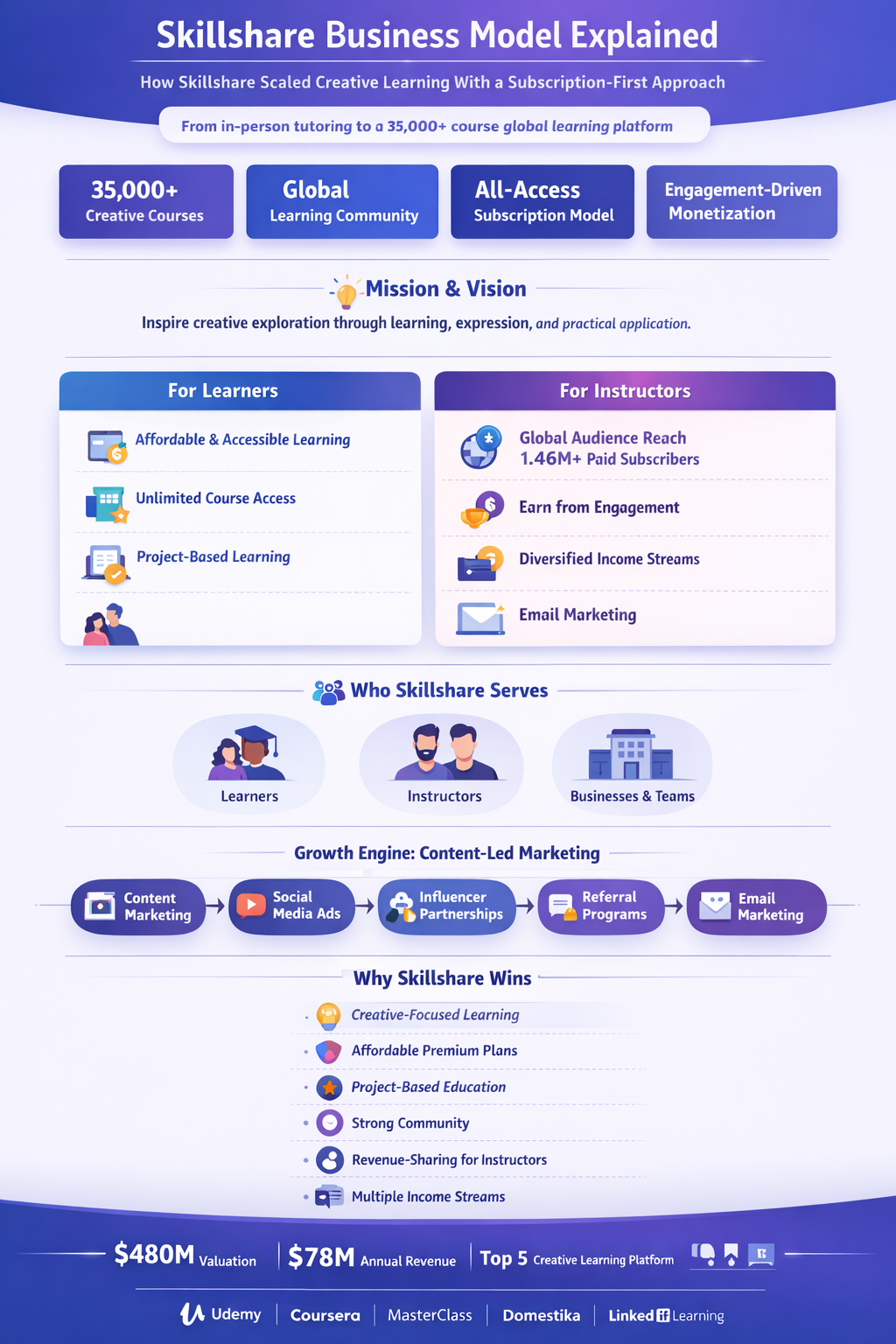
Skillshare evolved from in-person tutoring to a 35,000 extensive go-to course library for creatives. The platform leveraged an all-access subscription model instead of pay-per-course pricing. Its innovative business model empowers creative entrepreneurship and focuses on user engagement.
Let’s understand Skillshare’s business model and each business aspect in detail!
Mission & Vision
Inspire and encourage creative exploration for learning, expression, and practical application.
Value Proposition
For Learners
- Accessible & affordable learning: Skillshare provides both free and paid memberships, democratizing online learning and ensuring it is accessible to a global audience.
- Extensive library of courses: Learners get unlimited access to tens to thousands of courses covering technology, business, personal growth, and creative arts.
- Project-based and community learning: Includes short topic-based projects after each lesson, reinforcing skill-based learning and feedback.
For Instructors
- Global Audience: With an active community of 1.46 million paid subscribers, Skillshare helps instructors connect with a global audience.
- Monetize from engagement: Instructors can earn money from curated video lessons based on how well classes resonate with learners.
- Revenue diversification: Alongside subscriptions, instructors can sell templates, educational resources, 1-on-1 private sessions, and referrals.
Core Customer Segments
- Learners: Individual learners looking for skill development across diverse niches, entrepreneurs, creative professionals, hobbyists, and freelancers.
- Instructors: Subject experts, creatives, and niche celebrities who want to share their knowledge and monetize from their content.
- Businesses & Teams: Corporate teams and employees seeking upskilling programs and professional development.
Marketing Strategy
Skillshare focuses on content-led growth, partnerships, and performance marketing, rather than paid advertising.
Key Marketing Strategies:
- Content marketing: Skillshare creates educational content, such as blog articles, videos, and webinars. It leverages content as a marketing engine to attract high-value learners.
- Social media advertising: Promotes on Instagram, YouTube, and X, running targeted advertising campaigns to broaden potential learners and industry experts.
- Partnerships: Collaborates with well-known influencers, bloggers, and illustrators to promote their classes on YouTube, Instagram, and TikTok.
- Referral programs: Instructors can share their unique class referral link across social channels, blogs, or emails.
- Email Marketing: Learners get course recommendations, curated suggestions, and personalized learning paths through emails.
Competitive Advantages
Skillshare is among the top five creative learning platforms with a $480 million valuation and makes $78 million in revenue based on third-party estimates. Udemy, Coursera, MasterClass, Domestika, and LinkedIn Learning are among its top competitors.
Let’s look into the top competitive advantages!
- Focuses on creative skills and active community learning
- Affordable premium memberships involving expert-curated courses
- Project-based learning emphasizing on real-world application
- Community and collaborative features allow learners to connect and gather feedback.
- Revenue-sharing model and diverse income streams empower instructors to monetize from content.
Future Opportunities & Outlook
- Market Outlook: The global online learning industry is expected to reach $842.64 billion by 2030. The growth of digital learning platforms, remote learning, and corporate and upskilling learning is fueling the rapid growth. The global creative industry currently stands at a 2.5 – $3 million market value.
- AI-Led Growth & Opportunities: Skillshare is exploring AI content licensing deals and brand partnerships, adding an additional revenue stream for instructors. And the platform maintains complete transparency on how content will be used, the opt-out process, and payment structure.
- High-Demand Courses: From Generative AI to data science, web design, and digital illustration, Skillshare is constantly expanding future-proof skills. It includes quality video tutorials, project-based learning, and community support within its course scope.
- Skillshare for Teams: Enterprise subscription plans and corporate training are Skillshare’s new B2B expansion. It generated $17 million in 2026 from its corporate upskilling and employee training programs. With positive response from startups and top-tier organisations, Skillshare is expected to continue its professional training expansion.
- Future IPO listing plans: In August 2020, Skillshare raised a $66 million funding round led by OMERS Growth Equity. Although the company hasn’t made an official IPO listing announcement until early 2026, there is significant interest among investors.
Key Lessons for Businesses and Entrepreneurs
Planning to build a Skillshare-like platform? Here’s how to take inspiration from Skillshare’s journey and make a successful stride:
What Works:
- Subscription-based revenue model
- Community and collaboration-led growth is the MOAT.
- Instructor royalty and monthly earnings based on engagement
- Turn Instructors into platform marketers.
What Entrepreneurs Can Adopt:
- Community and project-based learning beyond the content library
- Monetization model based on user behaviour
- Diversification in both consumer and business segments
- Embrace AI as an expansion strategy.
Market Gaps:
- Cohort-based learning with live lessons and self-paced courses
- Explore underserved audiences and regional markets
Scope of Improvement in Skillshare Model:
- Certificate monetization
- Bite-sized lessons work better for mobile learning
- Practical AI lessons for specific professions
Final Thoughts
Skillshare’s remarkable journey has proved that industry focus, innovative business model and brand positioning assure long-term business success! At its core, Skillshare operates on a very simple philosophy — allow anyone to share their skills through affordable, high-quality classes.
The platform’s focus on creative learning, instead of a broader learning market, attracted many learners and even investors. Lastly, it built a solid community and leveraged its instructors as powerful marketers. The biggest opportunity lies in emerging AI, technology niches, creative entrepreneurship, and corporate segments.
If you’re inspired by Skillshare’s success story, Pinlearn can help you to launch a Skillshare-like learning platform with built-in monetization flows and powerful integrations. We have built successful businesses for others and can do the same for you; let’s get in touch and discuss your future roadmap!
💡Similar Blogs:
FAQ-Related to Skillshare Business Model
1. What are the fastest-growing course categories on Skillshare in 2026?
Generative AI tools, UX, copywriting, and digital illustration are the top course segments on Skillshare.
2. What is Skillshare’s business model?
Skillshare operates on a subscription-based revenue model, monetizing primarily from premium memberships, enterprise plans, and brand partnerships.
3. How do instructors earn on Skillshare?
Instructors’ monthly earnings are calculated based on the minutes of their classes watched and referral bonuses.
4. How does Skillshare compare to MasterClass for creative professionals in 2026?
Skillshare prioritizes project-based and community-driven learning under industry experts, while MasterClass provides high-quality lessons from celebrity instructors.
5. Is Skillshare available in multiple languages?
Skillshare’s content is available in five languages: English, French, German, Portuguese, and Spanish.
6. Can Skillshare content be licensed for other users?
Skillshare partners with content services for licensing and explores AI brand partnerships to build authority.